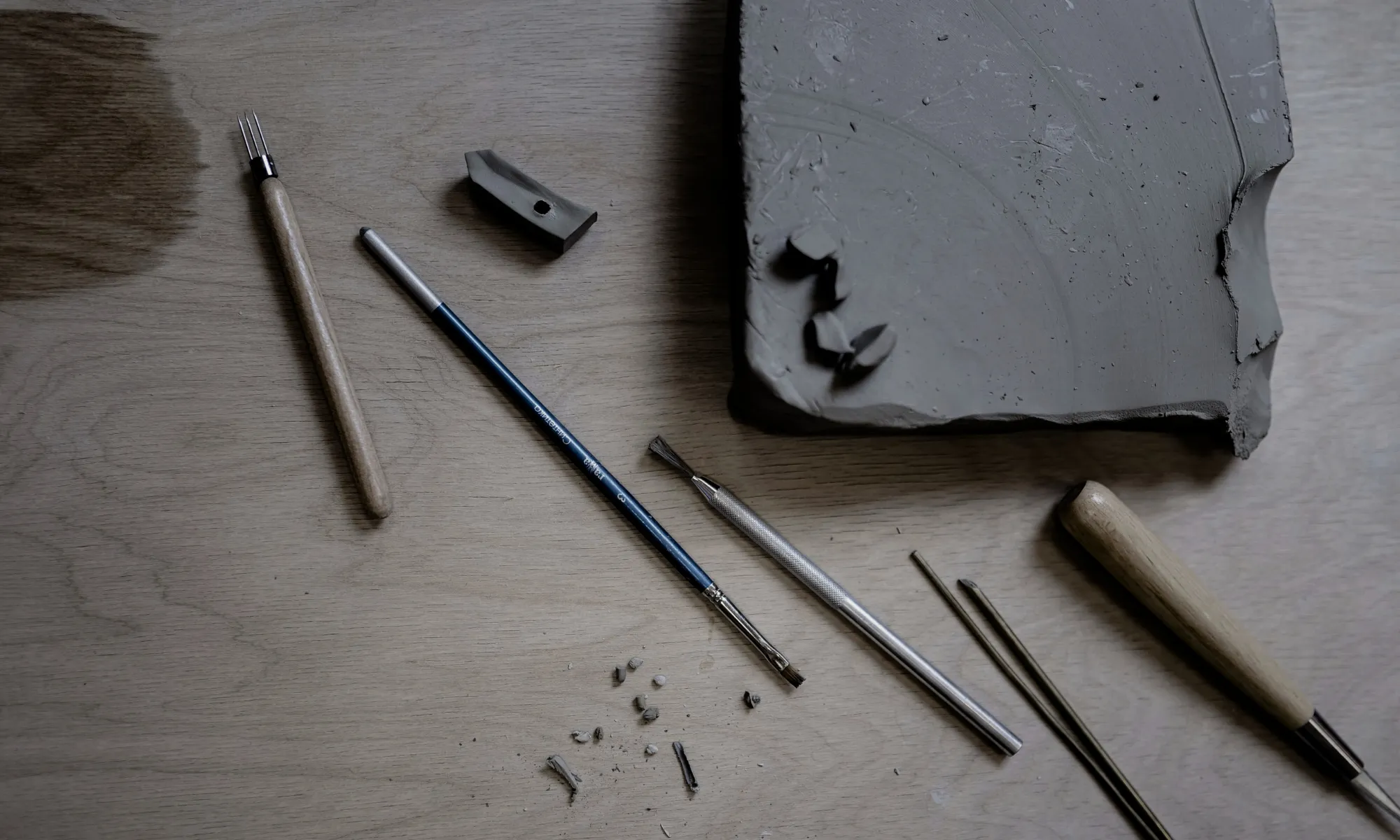

Plastic, docile, pleasant to the touch, loves moisture, leaves fingerprints and gets thoughts stuck in it, it is indisputably the most suitable material for improvisation. What is it? Clay for ceramics.
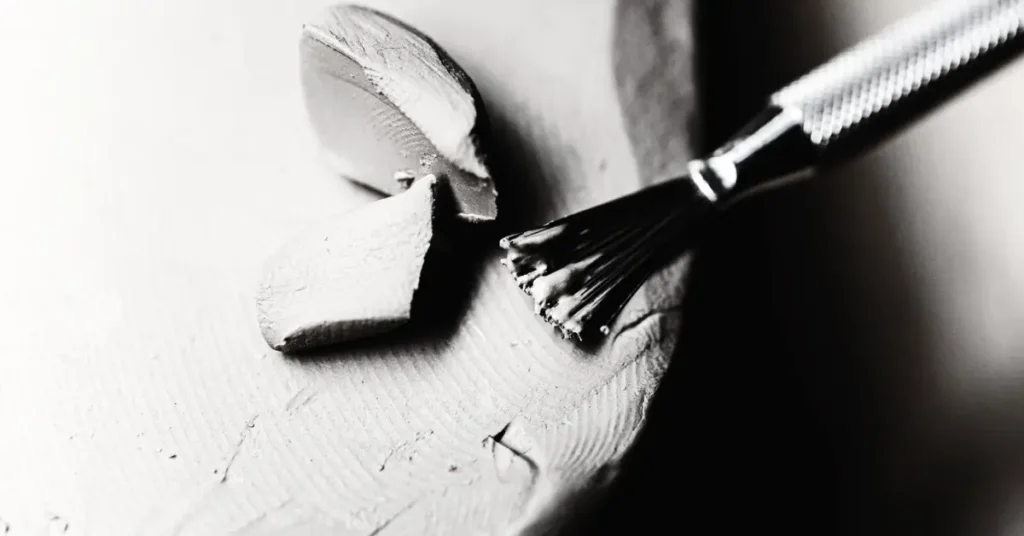
Sedimentary rock – clay for ceramics
Yes, it is the most suitable mineral material, one that not only indulges the maker but can also become a witness to the most important moment of a life, or to the memory of it.
The most characteristic feature of clay ceramics, as I have already mentioned, is its plasticity. Wet clay is easy to knead, roll, mold, stretch, and press, thus giving it the desired shape, which remains the same even after the clay has completely dried.
Firing in a kiln for firing ceramics causes the minerals in the clay mass (the product formed from it) to transform into a glassy phase. When producing a ceramic product for practical purposes (for household use or for wearing on the body), a single firing in a kiln is not enough.
After the first firing, biscuit (the name given to a once-fired ceramic piece) is already resistant to contact with the human body or with liquid, and it does not deform in damp conditions. Its surface, however, is still porous: it does not hold liquid and lets it pass easily through the walls of the piece. To use the piece in the household, the biscuit must be covered with glaze.
Glaze is a thin, glassy coating on the surface of a ceramic piece. It is applied to a piece that has already been fired once, to make it decorative and to protect its surface, that is, to give it water resistance and strength.
The choice of glazes today is genuinely wide. You can choose a matte, glossy, semi-transparent or colorless glaze. There are also reduction glazes, with metallic shades, and crackle glaze, which crazes once the piece has been fired.
A ceramic piece covered with glaze and fired in a kiln at a temperature above 1,000 °C acquires its characteristic properties: it becomes resistant to wear, heat and flame, long-lasting and non-toxic.
Glaze manufacturers offer an extremely wide choice, and every maker chooses the materials that, in their own judgement, best suit what they set out to do.
However strong and long-lasting ceramic pieces may be, a hard knock can still crack or break them.
Glazes containing lead are not used in the production of tableware, jewelry, or other household items.
Next I will briefly introduce the materials from which the „RAMUNĖS nameilė“ original works and art jewelry are made.
Clay masses and other materials are used to make ceramic items and jewelry: plastic (porcelain and clay) and brittle (chamotte).
The most valuable ceramic material is porcelain
The most valuable material in ceramics is considered to be porcelain, made from kaolin. Kaolin is also used in the faience and paper industries. After firing, it retains its characteristic white or almost white color. Black porcelain is also often used for jewelry production, which is distinguished by its beautiful black graphite shade and blue, an expressive cobalt blue shade.
The jewelry made from this material is light, has an exceptional range of colors and withstands the effects of the environment.
How clay behaves: drying and firing
Clays are sedimentary rocks - fine-grained mineral masses that, regardless of their mineralogical and chemical composition, when mixed with water form a plastic dough, which, when fired, turns into a waterproof and durable product.
Most often used is 100% natural clay for ceramics, which is ideal for modeling tableware and for making sculpture. A plastic clay body sticks to the hands at a touch and shines when a finger is drawn across it.
The plastic particles of the clay mass are covered with a film of water. As the clay loses the water between the particles, it loses its plasticity. Excess moisture must be removed gradually to prevent the product from deforming.
A piece that dries too quickly or unevenly cracks, because drying clay shrinks and its volume decreases. As a clay piece dries, the remaining voids fill with clay particles until the particles come to rest against one another.
From that moment on, the clay stops shrinking and loses its plasticity. Just as when it dries unevenly, when it is heated suddenly, the clay object crumbles into crumbs.
That is why, when pieces are fired in a kiln, the temperature is raised very gradually, so that sudden heating does not crumble the piece and so that, once fired, it becomes as hard as stone.
Chamotte
Clay with added material. The additions can be very varied. For „RAMUNĖS nameilė“ works, however, a gray-black plastic chamotte clay body is used, containing 25% of fired, ground clay grains (chamotte) 0–0.2 mm in size.
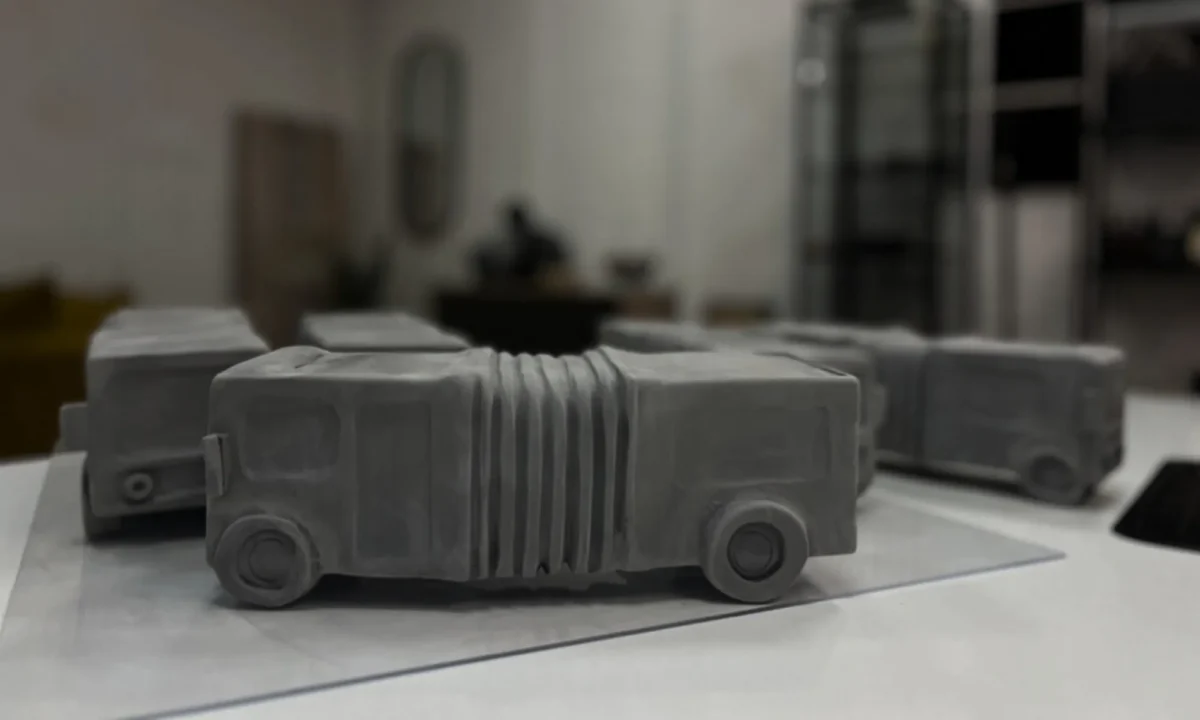
Additions are put into clay to improve its functional properties, so that larger, coarser ceramic pieces do not warp as they dry and hold their shape more steadily. This clay withstands severe cold as well as heat, so pieces made from it can stand for a long time outdoors as well as indoors. Chamotte is used for sculpturesthat decorate exteriors and interiors.
Glaze
All glazes used for ceramic tableware and ceramic jewelry are non-toxic, lead-free and do not contain any hazardous substances that would need to be declared in accordance with the regulations on the concentration levels of hazardous substances.
Precious metals in ceramics
Although various metals are associated with cold materials, it is non-ferrous metals that are characterized by warmth and perfect compatibility with other materials: ceramics, porcelain, or even chamotte.
Ceramic interior objects and jewelry with porcelain miniatures, decorated with gold or platinum lusters, stand for lasting values, because alongside unconventional materials precious metals ring out unexpectedly.
Clay ceramic pieces: from a wearable miniature to outdoor sculpture
The clay body often decides what a piece can become. But that is not a rule: knowing the properties of the material, an artist can venture into experiment and make something entirely of their own. Clay bodies are mixed with one another, because that is the only way to discover, to learn, to experience.
Porcelain – for the miniatures used in art jewelry. Light, deep in color, with a velvety surface. Although it looks fragile, the high firing temperature, often above 1,300 °C, makes porcelain mechanically stronger than an ordinary ceramic shard. It is this property that allows intricate forms of very small diameter, fit to be worn every day.
Chamotte – highly valued by artists and sculptors. It is the first choice for large sculptural objects, for planters and for outdoor ceramics. Resistant to both frost and heat, so pieces can be shown outdoors.
Natural clay – one of the most versatile natural materials, suited to ceramics, to modeling and to art. Tableware is modeled from it, and sculpture is made from it.
The most capricious piece
The most capricious piece in terms of materiality, one I return to each time as if to a blank sheet of paper, is the family hearth „Gijos“. It is built from separate sheets formed by hand, so their thickness is uneven. Because of that the piece takes on additional stresses as it dries, and out of those come cracks, splits and deformations.
But that is exactly why it matters to me. Each time I make a new one, I talk to it, stroke it and try to feel every bend, so that after the kiln I find it unchanged.
With inspiration, Ramunė
These same materials are also used at the creative celebrations held at the ceramics studio in Šiauliai.