


A christening is one of the most important rituals of the human life cycle, marking a new person's entry into a religious and social community. Although in contemporary society the christening is often seen as a family celebration, the creation of a relationship remains an essential part of its structure. Godparents hold a special place here – people who are given a specific role in the child's life. A gift for godparents can therefore be understood not merely as a thank-you or an attribute of the celebration, but as a material sign of a newly created relationship.
Godparenthood as a special social bond
The role of a godparent in the Christian tradition is not merely symbolic. The canon law of the Catholic Church states that a godparent, together with the parents, is to help the baptized child to live in keeping with baptism and to be brought up as a Christian (Code of Canon Law, 1983, can. 872). Godparenthood therefore means taking on a certain responsibility and creating a long-term relationship.
Historically, this relationship was not confined to a liturgical act either. Lynch (1986) showed that in Western Europe godparenthood gradually grew into what became known as spiritual kinship – a social bond understood as a particular form of kinship. Godparents could act as protectors, intermediaries, providers of religious instruction and creators of social trust.
In the Lithuanian tradition this bond was also understood broadly. Paukštytė (1999) links the role of godparents not only to the sacrament of Baptism itself, but also to a range of folk customs. Visuotinė lietuvių enciklopedija (the Universal Lithuanian Encyclopaedia) notes that in traditional culture ritual kinship (kūmystė) was understood as a special, even metaphysical bond, and that godparents were assigned responsibility for the godchild as well as a duty of guardianship should the parents die ("Lietuvių krikštynų papročiai").
The choice of a godparent therefore traditionally meant more than inviting someone to a ceremony. It meant bringing a particular person into the child's life as a significant adult.
The gift as a means of creating a social bond
To understand what a gift means at a christening, it helps to step back from the contemporary view in which a gift is seen mainly as an object with economic or aesthetic value. In anthropology, a gift is first of all examined as a mechanism for creating a relationship.
One of the most important authors of this theory is the French anthropologist Marcel Mauss. In his classic study The Gift Mauss (2002) showed that in many societies giving is not an entirely free act, independent of social relations. Three principal obligations operate within the gift system: to give, to receive and to reciprocate. In this way the exchange of things becomes an exchange of social relations.
What matters is that Mauss does not separate the gift from the person who gives it. The gift becomes a carrier of the relationship: the bond between people is sustained through the object. A gift is therefore not simply an object passed from one person to another. It acquires social meaning because it is embedded in a relationship.
This theory allows us to look differently at a gift for godparents. Seen this way, the gift becomes a material means of acknowledging and strengthening a newly formed bond. It is not payment to a godparent for a service rendered. On the contrary – its meaning arises from the relationship the godparent takes on.
Gifts for godparents and reciprocity
The link between giving and godparenthood emerges particularly clearly in anthropological research. Studying the practice of gift-giving between godparents and godchildren in Transylvania, Vasile (2018) showed that gifts within this relationship are bound up with a whole range of social categories: obligation, debt, care, solidarity, charity and mutual exchange. The author highlights the tension between two logics of the gift: on the one hand a gift can be part of an exchange, on the other it can be understood as an expression of care and solidarity.
This distinction matters for a christening gift for godparents too. It should not be understood as the simple principle "they gave something to the child, so we give something to them". Such a reading would narrow the meaning of the ritual too far and turn the gift into an economic exchange.
It is more accurate to see it as a confirmation of a mutual bond. Godparents commit themselves to an important role in the child's life, and the family, through the gift, symbolically acknowledges the weight of that commitment.
A similar link between gifts and ritual kinship is discussed by Hristov (2018), who studied godparenthood traditions in the Balkans. His research shows that baptismal rituals can create ties not only between individuals but also between families, ties sustained by symbolic rights, duties and exchanges of gifts.
The gift thus works as one of the means that keep ritual kinship alive.
In the Lithuanian tradition a gift is not only used but also kept
A particularly significant part of the Lithuanian christening tradition is the gift's connection with memory. In Lithuanian ethnographic material we find gifts that were intended not for short-term use but for safekeeping.
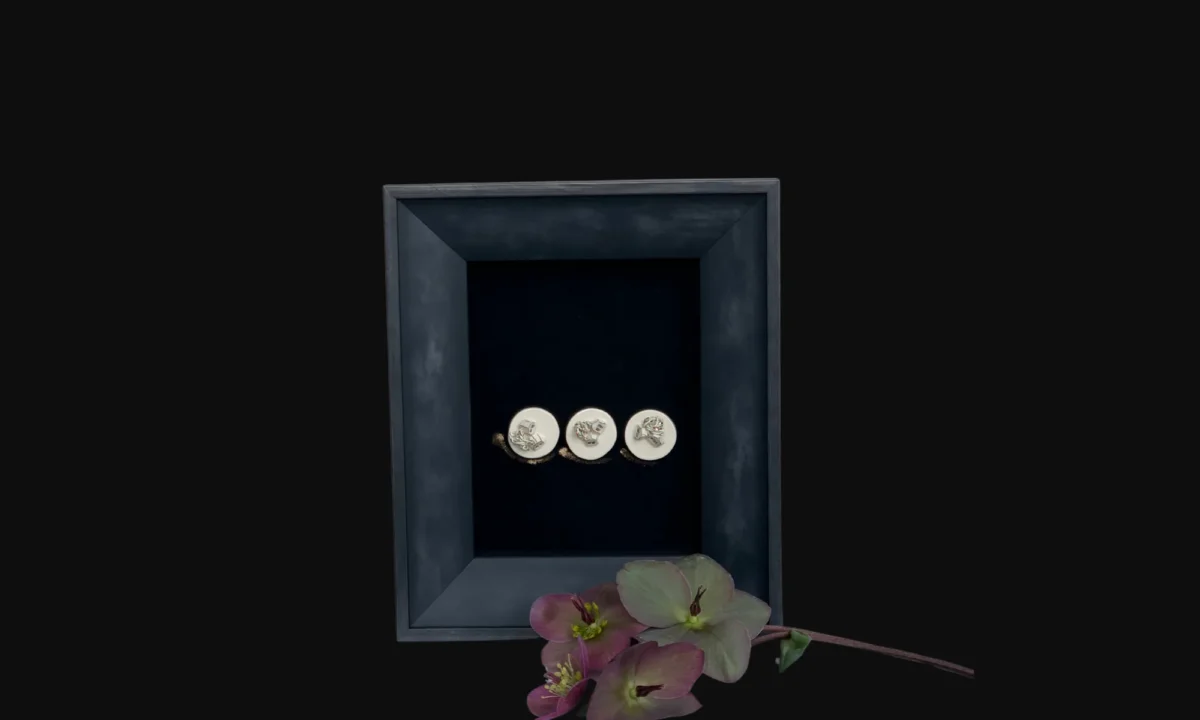
Visuotinė lietuvių enciklopedija records that in the early twentieth century the godmother would give the child a christening gown, and that in some regions of Lithuania there was a custom of giving a woven sash. In the area around Prienai such a sash could be kept until the person's death and was sometimes even placed in the coffin ("Lietuvių krikštynų papročiai"). This shows that a ritual object could outgrow its original purpose within the celebration and become an object of memory for a whole life.
Seen this way, a christening gift is not merely an attribute of the celebration. It can become a material form of memory.
A ritual is temporary: it takes place on a particular day and lasts a certain time. A gift remains. The object thus becomes a kind of material witness to the event – it can recall not only the day of the baptism itself, but also a person's role in it.
The gift as the materialization of a relationship
In this context we can speak of the materializing function of a gift. Godparenthood in itself is an immaterial social relationship. It cannot be shown physically. It exists through promises, responsibility, memories and the way people behave toward one another.
A gift gives that relationship a material form.
This matters especially in rituals where abstract notions – belonging, commitment, protection, memory, closeness – are expressed through concrete acts and objects.
It can therefore be said that a ritual gift performs at least three functions:
- it marks the event – it ties the object to a particular baptismal day;
- it gives meaning to the relationship – it expresses in material form the place godparents hold in the child's life;
- it keeps memory – it allows the beginning of the relationship to survive beyond the ritual itself.
In this way the object ceases to be merely an object. Its meaning arises from the relationship it stands for.
Why the symbolic rather than the economic value of a gift matters
The meaning of a gift within a ritual does not necessarily depend on its price. Mauss's theory allows us to separate the economic value of a gift from its social value. An object can be of modest economic value and yet be socially very significant, if it gives meaning to a particular relationship.
This is especially true of a christening. A gift meant for godparents is not payment for a function performed. Its value comes from what it means.
The qualities that matter in a ritual object may therefore be not luxury or material value, but:
- durability;
- individuality;
- symbolic depth;
- a connection with a particular person;
- the possibility of being kept;
- the ability to recall a specific event in a life.
From this perspective an authored work can carry particular meaning. Its value lies not only in the material or the hours of work, but also in the fact that it is not an entirely anonymous, mass-produced object. It can become the sign of a particular relationship.
A small object as the bearer of great meaning
In the context of christening gifts, the phenomenon of the small object is especially interesting. Small size does not in itself mean small meaning. On the contrary, a ritual object can work as a symbolic concentrate – gathering a great deal of personal and cultural meaning into a small material form.
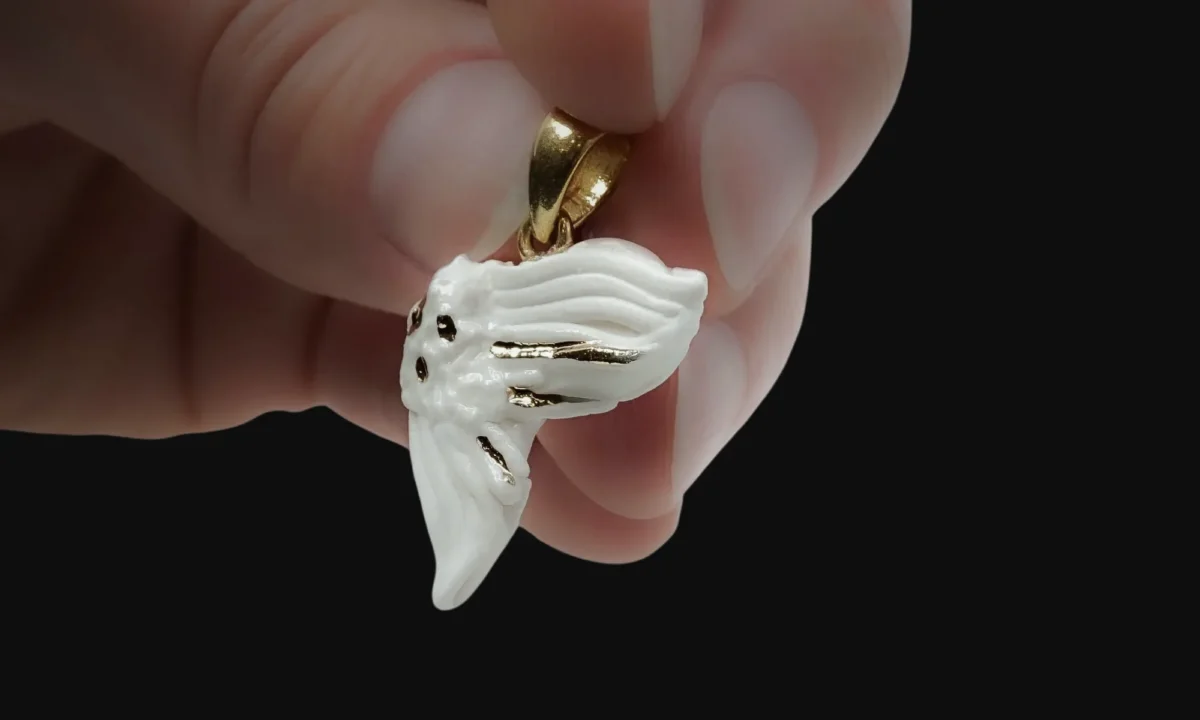
If such an object is given to godparents, it can mean not "thank you for the gift", but "thank you for the place you will hold from now on in our child's life".
This is a fundamental shift in meaning.
A gift is not meant only to be beautiful. It becomes a sign of a bond.
Its function could therefore be described as the materialization of a relationship: the invisible bond between the child, the parents and the godparents takes on a concrete, enduring form.
What to give godparents
Until now I have been writing as a researcher. Now I want to say what I encounter in the studio, because the question of what to give godparents is one I am asked often.
From everything set out above, one fairly clear criterion follows. A gift for godparents takes on immeasurable meaning only when it has lasting value. Not something consumed within a week, but something that can be worn or kept at home, and that ten years later still recalls what it means.
In practice this means a few things.
A sign that is worn. A pendant, a bracelet or a neckpiece comes closest to what the ethnographic sources describe: an object that travels with the person. For a godmother, the usual choice is a piece of jewelry, a pendant for example "Angel wing" or the bracelet with a porcelain cross. A gift for a godfather tends to be more restrained, for example the pendant "Namelis" ("Little home") or the bracelet "Geometric".
An object that stays at home. Not everything is meant to be worn. So the second direction is a small sculpture or an interior object that stands in plain sight and speaks for itself. The sculpture "Everyday Heroes" or "Support" is exactly about the role that godparents take on.
A work made for one particular story. The object that works most strongly is the one holding something found nowhere else: the christening date, the initial of a name, a symbol that matters to the family. Such works are born out of conversation and they need time, so it is worth talking about them well before the week of the celebration. How this happens is described on the page individual orders.
What is not worth choosing. The opposite list follows from the same logic. A souvenir inscribed „To the best godparents“ says only that a gift had to be bought. An object whose single message is its price returns the relationship to an exchange. And what is eaten or used up the same evening may be a pleasant small thing, but it will not become a carrier of memory.
None of these choices is a rule. But all of them rest on the same question: ten years from now, will this object still be able to recall the day two people committed to being important in a child's life.
In summary
A christening gift for godparents has meaning because godparenthood itself is not merely a ceremonial role. It is a bond created during the ritual and socially recognized, with a religious, a moral and an interpersonal dimension.
The anthropological theory of the gift allows us to understand it as a means of creating and sustaining a relationship, while research on godparenthood shows that giving is closely bound up with commitment, care, solidarity and ritual kinship. The Lithuanian christening tradition shows in addition that objects connected with baptism can become long-lasting bearers of memory.
A gift for godparents can therefore be understood neither as payment nor as a formal souvenir of the celebration. Its essence is to mark a relationship that begins, or is affirmed anew, during the ritual of baptism.
In this way the gift becomes a material testimony to an immaterial commitment: to trust, responsibility, closeness and the promise of being present in another person's life.
Its value lies not in what it costs, but in what it keeps.
- Hristov, P. (2018). Bulgarian ritual kinship (Kumstvo): Old patterns, established beliefs, and new trends. Journal of Family History, 43(1), 72–87. https://doi.org/10.1177/0363199017738187
- Code of Canon Law (1983). Book IV, cann. 872–874. Vatican. https://www.vatican.va/archive/cod-iuris-canonici/eng/documents/cic_lib4-cann834-878_en.html
- Lynch, J. H. (1986). Godparents and kinship in early medieval Europe. Princeton University Press. https://doi.org/10.2307/j.ctvct001m
- Mauss, M. (2002). The gift: The form and reason for exchange in archaic societies (W. D. Halls, trans.). Routledge. (Originally published as "Essai sur le don", L’Année Sociologique, second series, vol. I, 1923–1924.)
- Paukštytė, R. (1999). Krikštatėvių vaidmuo krikštynų papročiuose (XIX a. pabaiga–XX a. I pusė) [The role of godparents in christening customs, late 19th to mid-20th century]. Etninė kultūra ir tapatumo išraiška (Etnologiniai tyrinėjimai Lietuvoje 1992, 1993 ir 1995) [Ethnic culture and the expression of identity] (pp. 173–178). Vilnius.
- Vasile, M. (2018). The gift of the godfather: Money and reciprocal exchanges in spiritual kinship relations in Transylvania. Journal of Family History, 43(1), 30–50. https://doi.org/10.1177/0363199017738175
- Visuotinė lietuvių enciklopedija. Lietuvių krikštynų papročiai [Lithuanian christening customs]. https://www.vle.lt/straipsnis/lietuviu-krikstynu-paprociai/
Wishing you moments beyond price,
Ramunė