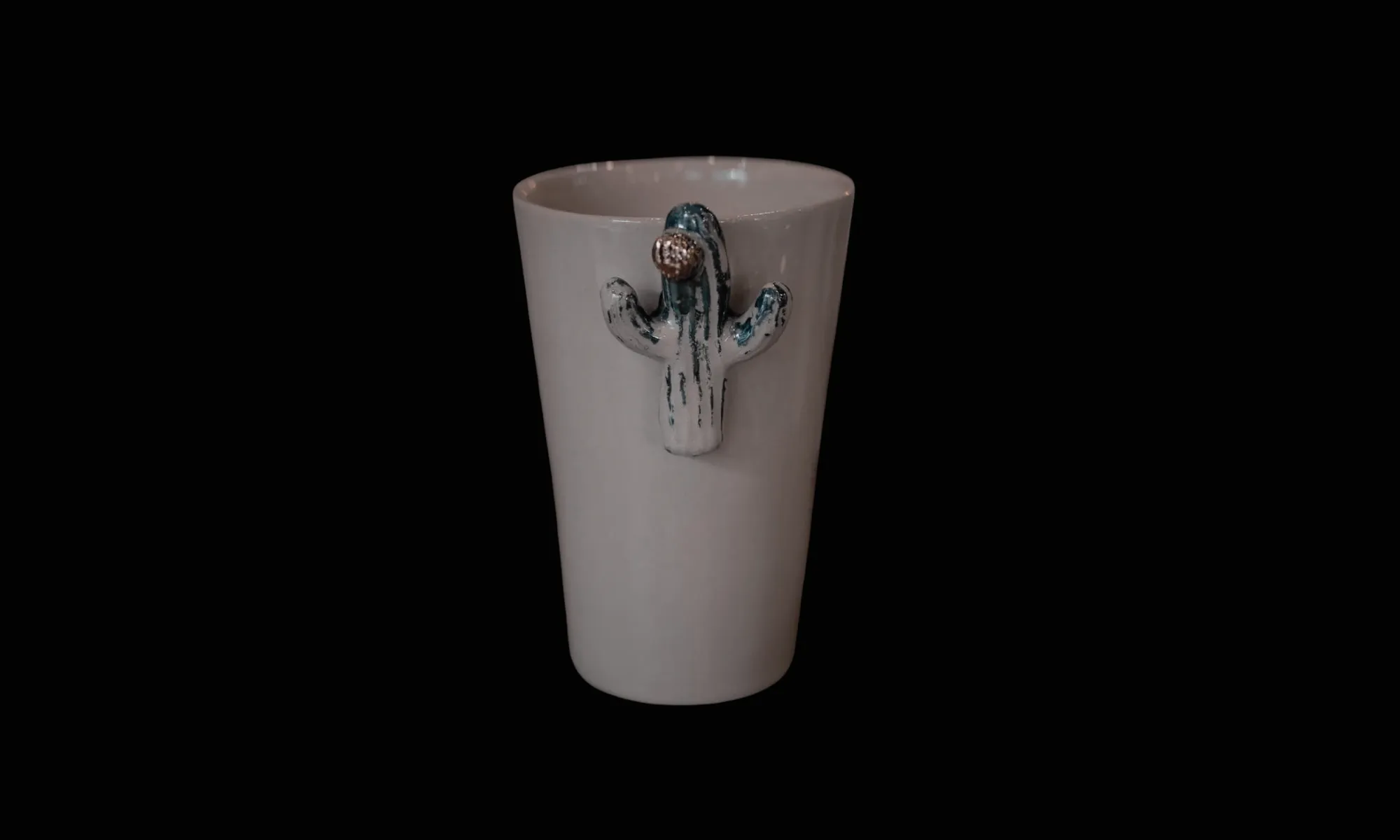

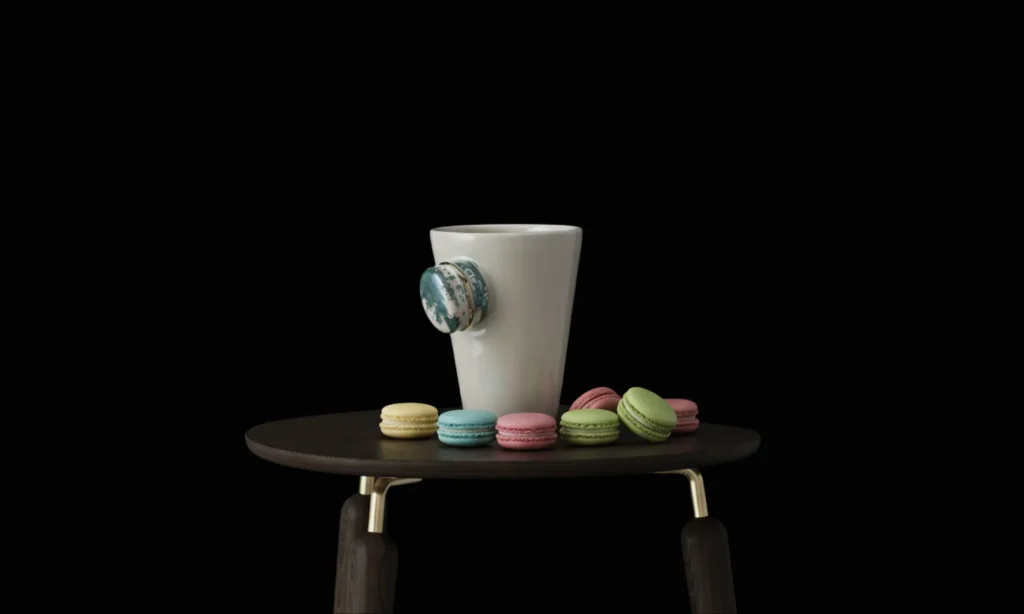
The world changes, but a morning with a cup of coffee or tea stays. Handmade ceramic cups give this ritual more than function: they are material made to speak, an expression of the maker's aesthetic that we feel in our palms. In this text we travel from the ceremonies of the East to European tea culture, to understand why a unique handmade cup so quickly becomes "ours".
We will look at the path through continents and periods: how the vessel arrived in Europe, how its shape and decoration changed, what meanings it acquired in different traditions. Finally, what the handmade cup means today: for daily rituals, conscious choices, and sustainability.
Japanese tea ceremony bowl (chawan)
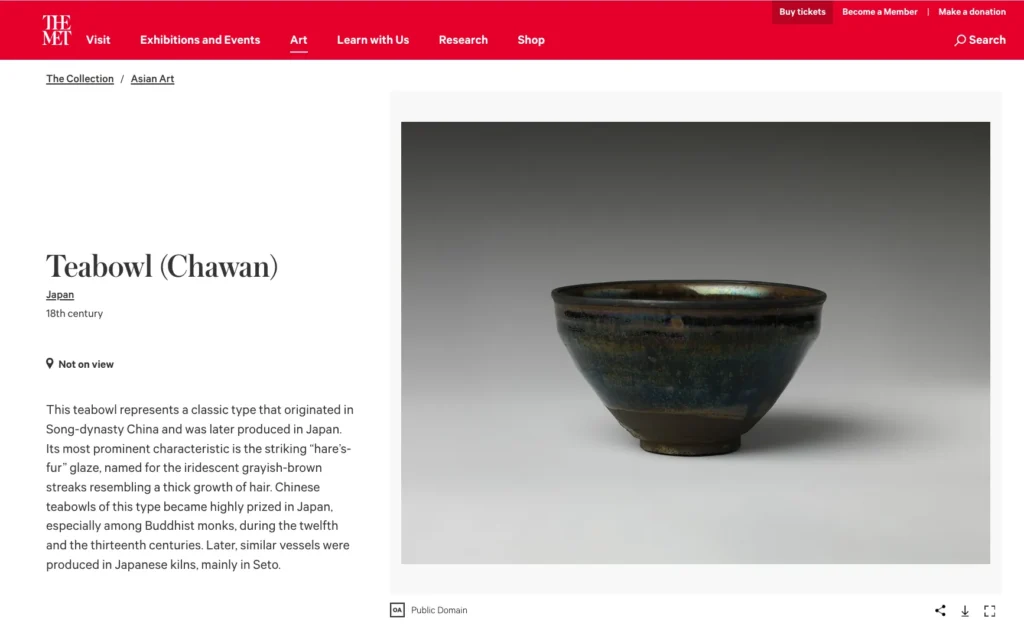
The chawan bowl used in the Japanese tea ceremony is an essential ritual object with deep cultural, philosophical and aesthetic meaning. Although at first glance it is a simple vessel, the chawan is regarded as a work of art: the best examples are declared national treasures, and craftsmen pay special attention to the bowl's shape, proportions, glaze character and origin.
Chronologically, aesthetics changed radically. Initially, ornate Chinese porcelain bowls (tenmoku) were used, but by the end of the 16th century, with the establishment of the wabi-sabi mindset by Sen no Rikyū, more modest, asymmetrical Korean ido-type bowls were consciously chosen, due to their simple shape and naturally uneven glazes.
A unique Japanese tradition soon took shape: handmade bowls by Raku masters, often in black or red earth tones, with restrained, palm-friendly shapes, embodied the ideal of wabi – the search for true beauty in simplicity and imperfection. Thus, the everyday vessel became a symbol of spiritual aesthetics: value was measured not by the luxury of the material, but by the experience of the ritual and the gesture of the master's hand.
The Middle Eastern coffee cup tradition
In the Middle East coffee became an important social ritual, and the small cup became its sign. Traditionally, strong Arabic coffee is served in handleless porcelain cups called finjan. A small portion is poured and often topped up: this rhythm makes it possible to hold a hot vessel, but it also underlines the meaning of the hospitality itself, since every pouring is a gesture of attention.
Offering a guest coffee here signifies hospitality and goodwill. It is not just a drink, but a social code: to accept a cup is to accept a connection, to participate in a conversation, to join in the fellowship.
In the palaces of the Ottoman Empire, serving coffee became a sophisticated protocol. A small porcelain cup was placed in an ornate holder (zarf) and served to guests by special servants; there was even a separate position – the head coffee chef, responsible for the impeccable taste and presentation. From the 16th century, Chinese porcelain cups – thin, shiny, perfect for hot coffee – also came into this world in abundance.
Thus, the finjan became more than a vessel: small, without a handle and easy to hold in the fingers, it embodies oriental hospitality. Sip after sip, refill after refill - coffee brings people together, and the cup becomes a symbol of communication, inseparable from the ritual experience itself.
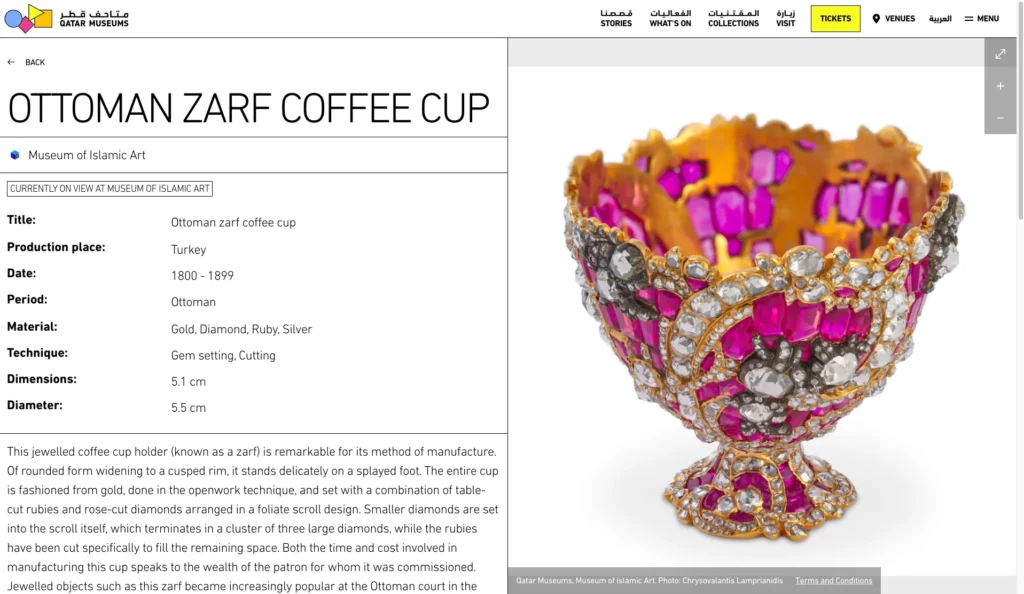
- Finjan – a small, usually porcelain or ceramic cup without a handle, made for drinking strong Turkish, Arabic or Balkan coffee.
- Zarf – a metal, richly decorated holder (most often copper, brass, silver, sometimes even gold) into which the finjan cup was set.
It served two purposes.
- Practical. Coffee was served very hot and the finjan cup had no handle, so the zarf protected the drinker's fingers from burning.
- Aesthetic and social. Ornate zarf holders made of precious metals were a sign of luxury and high social status, emphasizing the host's hospitality and wealth. They were an integral part of the coffee ceremony.
So the finjan and the zarf formed an inseparable pair in traditional coffee culture.
The path of tea and coffee to Europe
Tea and coffee arrived in Europe in the 16th and 17th centuries, introducing new tastes and new utensils to Europeans' everyday lives. The first tea bowls appeared with Portuguese and Dutch merchants from the Far East; in the 17th century, especially in England, tea became popular, and utensils changed along with it.
It was unusual for Europeans to drink a hot drink from a vessel without a handle, so handles were soon attached to Chinese bowls. This gradually led to the development of a distinctive set of tea and coffee dishes with saucers.
At the same time, coffee spread through Venice, Vienna and London: in the mid-17th century, the first European cafes opened, and coffee houses became a part of urban life. At first, coffee was served in small cups, reminiscent of the Middle Eastern tradition, but over time, a distinctive style of coffee drinking developed in Europe.
Meissen Manufactory
A turning point in the history of European porcelain was the founding of the Meissen manufactory. In 1710, Elector Augustus II the Strong of Saxony established it in Albrechtsburg Castle, which guarded the secrets of the "white gold" for more than a century.
The technological basis was prepared even before the manufactory was founded: in 1708–1709, Johann Friedrich Böttger, continuing Ehrenfried Walter von Tschirnhaus' experiments with kaolin, discovered the composition and firing of hard porcelain in Saxony.
Early Meissen wares included the famous Böttger red stoneware (Böttgersteinzeug). The commercial debut of hard porcelain took place at the Leipzig Easter Fair in 1713, marking the beginning of the era of European porcelain fashion.
In order to protect the origin of its products, around 1722 the manufactory established the crossed swords mark – one of the oldest trademarks in the history of ceramics.
The cup as an instrument of manners and display
England offered a unique response: the bone china formula developed in the mid-18th century allowed the production of extremely thin but sturdy tea sets suitable for everyday use – thus local production began to compete more and more successfully with imports from China.
In the early 19th century, porcelain workshops and factories in Germany, France, Italy, and elsewhere supplied the market with cups decorated according to local tastes.
Ornate dinnerware became not only a part of everyday life, but also a sign of status: collectible oriental porcelain gave way to European aesthetics, and tableware became not only a function, but also a tool of manners and representation.
The cult of English teacups
In England, tea drinking grew into a cult of its own in the 18th and 19th centuries: a cup of tea became the centre of social life and a mark of national identity. Although tea had been drunk since the 17th century (the custom is linked to Catherine of Braganza, wife of King Charles II), it was between the late 18th and the 19th century that the tradition of afternoon tea took shape, with its own etiquette and its own set of vessels.
This ceremony required everything: a beautiful teapot, a milk jug, saucers, and, of course, special cups. English potters, from Josiah Wedgwood to later manufactories, refined their native pottery and porcelain to meet the growing demand.
Bone china cups were famous for their milky white hue, thinness, and strength, making them ideal for everyday and formal occasions. The sets were collected, passed down from generation to generation, and treasured.
The symbolic meaning of the cup is hospitality
Fashions have changed: from the baroque ornamented forms of the 17th–18th centuries, through the pastel floral motifs of the Victorian era to the rigor of 20th-century modernism. However, the symbolic meaning of the cup has remained stable – hospitality and coziness. Offering a cup of tea means showing care, inviting for a conversation, creating a small island of peace in everyday life.
A small but interesting detail: in the 19th century, it was a common custom to briefly pour tea into a saucer to cool it faster – the so-called „saucering.“ The saucer here served not only as a decoration, but also as a practical cooling device.
Modern trends: rituals, design and sustainability
In the era of mass production, we are increasingly returning to handmade ceramic mugs. Not to fill a collection, but for a relationship: to an object that speaks with material, warmth and form. Such a ceramic coffee or tea mug is not just „another“ one – it becomes a symbol of everyday life, inscribed in the daily rhythm.
The ritual is simple: the palm remembers the shape, the lips – the edge line, the thoughts – calm down in the trembling drink. The favorite cup encourages you to slow down, to feel the temperament of the day, the weight of thoughts. The drink seems tastier not only because of the receptors, but because of the experience that the body recognizes. This seemingly small personal choice gives the day a fulcrum.
Design leans towards the organic and the material: earth tones, a softly matte surface, proportions that "fit the palm". More and more often we choose the work of local ceramicists – small series rather than mass-produced pieces, works in which the maker can be recognised. Function and aesthetics go together: the capacity is matched to the habit (espresso, filter coffee or tea), the handle to the fingers, the form to the everyday ritual.
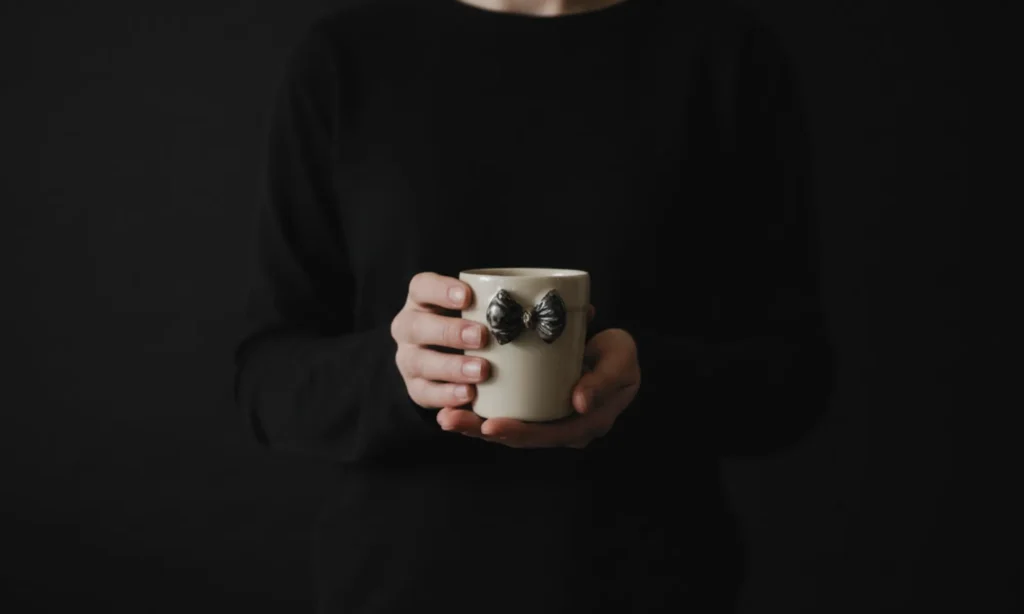
It's not just the look that matters here, but also the feel
Sustainability only strengthens this comeback. A reusable ceramic mug replaces disposable tableware, and long-term use becomes the simplest ecological gesture. Ceramic with a silicone lid is suitable for travel, and at home - a favorite mug that will last for years.
It is not only a responsible choice, but also an aesthetic one: beauty that comes from daily use and durability.
Give a ritual, not a thing
Because such a gift takes on a different weight. Handmade mug for a gift – personal, easily customizable (color, pair of two, subtle inscription) and it is truly a cozy and necessary item for everyone: it naturally settles into a person's life. Every morning becomes a small place of remembrance about the connection with the giver.
How to choose? Go by habit and by feel. Think about which drink you most often have; whether the handle matters more, or the small sculpture on the cup; which rim and which surface feel good against the lips.
Choose pieces based on aesthetics and comfort, and creator choose one whose working ethic is close to yours; that way you can be sure the cup is not only beautiful but also safe to use, made from food-grade materials and covered with lead-free glazes that meet Lithuanian hygiene norms and EU regulations.
Instead of an ending
Let the cup ignite a small spark of meaning every day – between the thinking hands of the master (Sennett1) and a simple but properly performed action (Rikyū2) artistic experience is born.
Japan
Okakura, K. (2007). The book of tea. Tuttle. (Original work published 1906)
Pitelka, M. (Ed.). (2003). Japanese tea culture: Art, history, and practice. Routledge.
Sen, S. XV. (1998). The Japanese way of tea: From its origins in China to Sen Rikyū. University of Hawai‘i Press.
Varley, P., & Kumakura, I. (Eds.). (1989). Tea in Japan: Essays on the history of chanoyu. University of Hawai'i Press.
Cort, LA (2000). Shigaraki, potter's valley (Rev. ed.). Weatherhill.
Ruch, B. (2002, October). The Japanese tea ceremony. In Heilbrunn timeline of art history. The Metropolitan Museum of Art. Available online: https://www.metmuseum.org/toah/hd/jtea/hd_jtea.htm
Raku Museum, & NHK Promotions. (2015). Raku: A cosmos in a tea bowl – Transmitting the secret art of Raku [Exhibition catalogue]. Raku Museum. Available online: https://www.jpf.go.jp/e/about/press/2015/dl/2015-012.pdf
Middle East
Hattox, RS (1985). Coffee and coffeehouses: The origins of a social beverage in the medieval Near East. University of Washington Press.
Morris, J. (2018). Coffee: A global history. Reaction Books.
Uckers, WH (1922). All about coffee. The Tea and Coffee Trade Journal Company.
UNESCO. (2013). Turkish coffee culture and tradition (Representative List of the Intangible Cultural Heritage of Humanity). Available online: https://ich.unesco.org/en/RL/turkish-coffee-culture-and-tradition-00645
UNESCO. (2015). Arabic coffee, a symbol of generosity (Representative List of the Intangible Cultural Heritage of Humanity). Available online: https://ich.unesco.org/en/RL/arabic-coffee-a-symbol-of-generosity-01074
Pera Museum. (2022, September 30). The Ottoman way of serving coffee. Pera Museum. Available online: https://www.peramuseum.org/Blog/The-Ottoman-Way-of-Serving-Coffee/3256
Europe
British Museum. (n.d.). Tea-bowl and saucer (Chelsea Porcelain Factory), ca. 1753–1757 [Object entry]. British Museum. Online access: https://www.britishmuseum.org
Cassidy-Geiger, M. (2007). Fragile diplomacy: Meissen porcelain for European courts, 1710–1763. Yale University Press.
Ellis, M., Coulton, R., & Mauger, M. (2015). Empire of tea: The Asian leaf that conquered the world. Reaction Books.
Hohenegger, B. (2007). Liquid jade: The story of tea from East to West. St. Martin's Press.
Meissen Porcelain Manufactory. (n.d.). History. Meissen. Online access: https://www.meissen.com
Rappaport, ED (2017). A thirst for empire: How tea shaped the modern world. Princeton University Press.
Spode Museum Trust. (n.d.). Development of bone china. Spode Museum Trust. Online access: https://www.spodemuseumtrust.org
Victoria and Albert Museum. (n.d.). Porcelain in Europe, 1710–1750. Victoria and Albert Museum. Online access: https://www.vam.ac.uk
General sources
Adamson, G. (2018). Fewer, better things: The hidden wisdom of objects. Bloomsbury. Available online: https://www.bloomsbury.com/us/fewer-better-things-9781632869647
Csikszentmihalyi, M., & Rochberg-Halton, E. (1981). The meaning of things: Domestic symbols and the self. Cambridge University Press. Available online: https://www.cambridge.org/core/books/meaning-of-things/7AB6CD87B8C85B99FFE79DB86811C5A2
Dormer, P. (1997). The culture of craft. Manchester University Press. Available online: https://manchesteruniversitypress.co.uk/9780719046186
Korn, P. (2013). Why we make things and why it matters. By David R. Godin. Available online: https://www.godine.com/book/why-we-make-things-and-why-it-matters
Sennett, R. (2009). The craftsman. Yale University Press. Available online: https://yalebooks.yale.edu/book/9780300151190/the-craftsman/
Lithuanian Hygiene Standard HN 16:2011. (2014). Special health safety requirements for materials and articles intended to come into contact with food. Ministry of Health of the Republic of Lithuania. Available online: https://e-seimas.lrs.lt/portal/legalAct/lt/TAD/TAIS.398339/asr?positionInSearchResults=4&searchModelUUID=268ad663-16a7-4cb1-9999-2570ba932fbd
European Parliament and Council. (2004). Regulation (EC) No 1935/2004 on materials and articles intended to come into contact with food. Official Journal of the European Union, L 338. Prieiga internetu: https://eur-lex.europa.eu/legal-content/EN/TXT/?uri=CELEX%3A32004R1935
Commission of the European Communities. (2006). Commission Regulation (EC) No 2023/2006 on good manufacturing practice for materials and articles intended to come into contact with food. Official Journal of the European Union, L 384. Prieiga internetu: https://eur-lex.europa.eu/legal-content/EN/TXT/?uri=CELEX%3A32006R2023
Footnotes
- “"Every good craftsman conducts a dialogue between concrete practices and thinking." —Richard Sennett, The Craftsman, 2008. ↩︎
- “"Tea is nothing but this: first you heat the water, then you make the tea, and then you drink it properly." [茶の湯とは、たち湯を流かし、茶を点てて、飲むがこななる事と知るべし。] — attributed to Sen no Rikyū, 16th century. ↩︎