
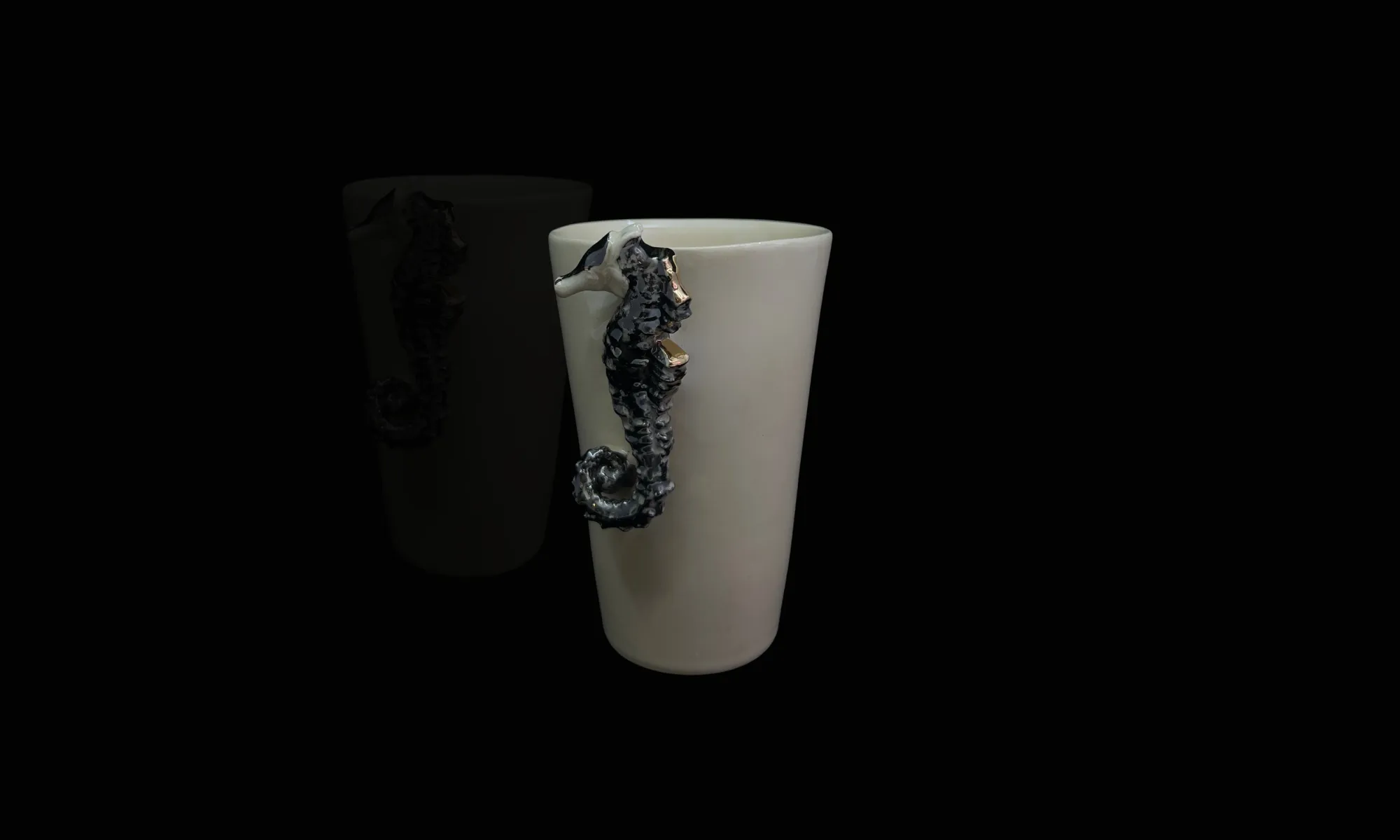

Imagine a morning. Light streams into the room through the window, and you hold a ceramic mug brimming with warmth in your hands. It is not just a container for coffee or tea. It is a companion to your daily ritual, a silent witness to your thoughts, gathering peace and promise for a new day. A handmade mug can become such a special friend – a small work of art that not only pleases the eye, but also gives an experience.
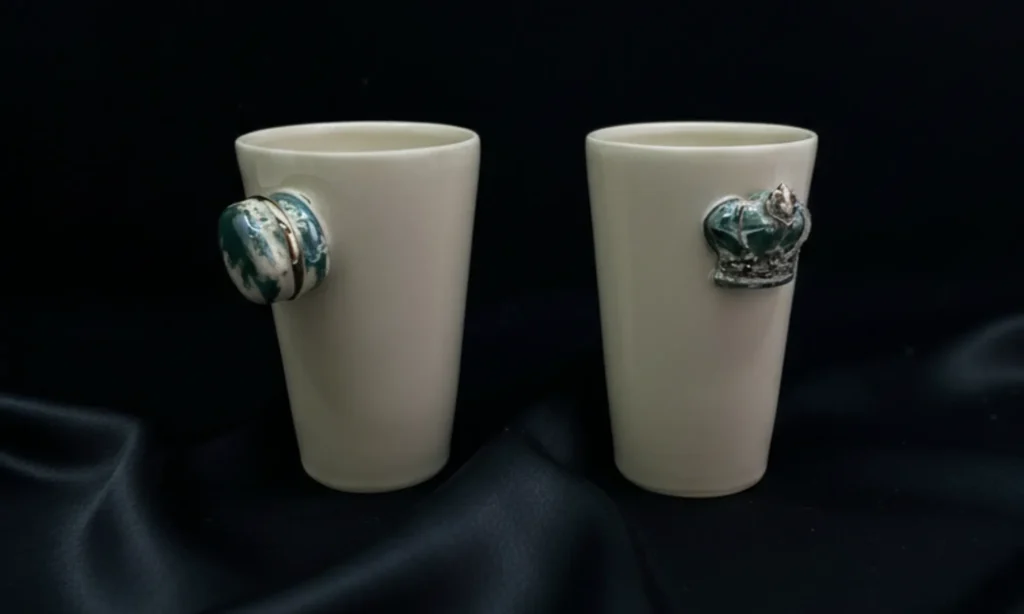
But how do you tell real craftsmanship from surface beauty? How do you choose a cup that will serve for years without betraying you with an unexpected crack, a strange aftertaste or a faded colour?
This account is a journey into the depths of the world of ceramics. Drawing on reliable sources, I will describe the technical secrets that lie behind a perfect cup. I will also show how to recognise quality not only with the eyes, but with the fingertips, and even by sound.
Base material: clay, stoneware or porcelain?
Every cup begins its life as a lump of clay, but its fate is decided by composition and by the trials of fire. The type of ceramic is the single most important indicator of quality.
Clay: Earthy but demanding
This is ceramic fired at a low temperature (around 800–1000 °C), with a porous structure. After firing, the clay body remains fairly permeable: its water absorption can reach 5–10 % or more. What does that mean for you? Dip an unglazed clay cup in water and it will soak up moisture like a sponge. For this reason handmade vessels made from low-fired clay have to be well covered with glaze. Without it, a cup, a bowl or a vase will not only absorb liquid but may also "sweat" on the outside.
Durability: Unfortunately, low-fired clay ceramics are fragile. They tend to crack even from the slightest impact. Therefore, low-fired ceramic cups are often made more massive, with thicker walls, but even this does not guarantee durability.
And the dishwasher, which most of us can no longer imagine a household without, is – to put it mildly – not suitable for handmade clay vessels.
Stone mass: solid and reliable character
This is ceramic fired at a high temperature (~1170–1250 °C), made from a mixture of clay and fluxing rocks (most often feldspar). Because of the high firing temperature its particles sinter firmly, and the ceramic body becomes exceptionally dense and therefore impermeable to liquid.
Strength: stoneware is far more resistant to impact and chipping than clay. Its structure is dense and firm, close to stone. Although handmade stoneware vessels have somewhat thicker walls than porcelain or earthenware ones, they are an excellent choice for everyday use: reliable and long-lasting.
Porcelain: ceramic steel
This is the highest grade of ceramic, made from kaolin, quartz and feldspar and fired at a particularly high temperature (~1250–1400 °C). Once fired, porcelain becomes almost entirely impermeable to water: its absorption does not reach 0.5 %, and is often nil. This means the porcelain body is as non-porous as glass.
Durability: Porcelain is exceptionally durable. Although its walls can be surprisingly thin and elegant, it is extremely resistant to impacts and scratches. Porcelain is used to create lightweight, thin-walled, yet very durable tableware.
A distinctive feature is the sound
Due to the extremely dense structure of the shard, when gently tapped on a porcelain dish, it emits a clear, melodious sound, like a small bell.
The sound of stone mass will be somewhat muffled, while clay will be extremely muffled. This sound test is one of the most reliable ways to distinguish quality. A muffled sound can signal not only a porous material, but also an invisible crack in the product.
Conclusion: For everyday use, the most reliable choice is high-fired ceramics – stoneware or porcelain. These cups will be strong, hygienic and long-lasting.
Firepower: Why combustion temperature is the basis for quality
A high firing temperature (~1200 °C and above) is the essential condition for a cup, a bowl or a vase to become not only beautiful but also functional. At roughly that temperature the ceramic body reaches maturity: some of its minerals melt, filling the microscopic pores and turning the ceramic body into one solid, glassy mass.
Hygiene: The dense, almost non-porous surface does not absorb beverage residues, odors or other undesirable phenomena. Such a cup, even after long use, will not change its characteristics, the glaze will not crack, it will not absorb unpleasant odors and will not change the taste of the drink, it will retain its color unchanged. Ceramics are a chemically inert material, so the drink from a quality cup is pure, "without additional spices.".
Dangers of low temperatures: A clay body fired at a low temperature stays porous. Moisture that penetrates those pores can become a site for bacteria or mould, and in time the cup takes on an unpleasant smell of damp earth. The colour may change and surface damage may appear. This does not mean such a cup cannot be used. It will, however, ask for more care: wash it by hand only, and drying it with a cloth will not be enough, since the vessel has to dry in a well-ventilated place, which means a closed cupboard or drawer is not the best solution.
Glaze: not only beauty, but also a protective shield
Glaze is a glassy layer that performs two important functions: providing an aesthetic appearance and sealing the surface. However, not all glazes are created equal.
Glossy, matte, or crackle? Feel and practicality
Glossy glaze
Glossy glazes create a completely smooth surface. They are extremely practical: easy to clean, resistant to stains and scratches. The smooth rim of the cup fits nicely on the lips, making drinking from such a cup a real pleasure.
Matte glazes
Matte glazes look cozy and warm, and their surface often has a silky finish. However, on a microscopic level, they are a bit rougher. This makes them more prone to accumulating deposits (such as from coffee or tea), and food particles can get stuck in the smallest irregularities. This doesn’t mean that matte mugs should be avoided, they just require more careful care.
Crackle glaze
Craquelure glaze is a specific decorating technique in ceramics, used to produce a dense network of cracks in the glaze on the surface of a piece, formed by the differing expansion coefficients of the ceramic body and the glaze during firing. In some cultures – in the Japanese philosophy of kintsugi, for instance – cracks are valued as part of an object's history. They are deliberately brought out by running ceramic ink into them and saturating them with gold dust, producing a striking visual effect. Artistically this is a respected technique, but in the Western tradition a functional vessel is held to strict hygiene requirements, and here the craquelure effect is considered a defect rather than a value.
The biggest danger is cracked glaze
Glaze cracking can look very different visually. Sometimes a solid mark of superficial glaze cracking or a spiderweb of small cracks may appear on the surface of the glaze. In all cases, this means that the expansion coefficient of the ceramic shards and the glaze is not compatible with each other. Liquids penetrate the ceramic vessel through the cracks in the glaze, and over time, dirt accumulates, which becomes a „warm nest“ for bacteria. Over time, these cracks darken from tea or coffee stains, changing the aesthetic appearance of the product.
In conclusion: for all the artistic charm of craquelure (from the French craquelé, "cracked"), for everyday use choose a cup with an unbroken, undamaged glaze.

Buyer's Guide: Practical Tests to Help You Recognize Quality
Armed with this knowledge, you can confidently embark on your search for the perfect cup. Here are some simple but effective tests you can perform in a store, at a fair, or at home.
1. Evaluate with your eyes
In good light, look the cup over carefully. Search for the glaze defects listed earlier: cracks, "pinholes" (tiny dots through which moisture can enter the piece), unglazed areas inside the cup. A precisely covered surface reveals the maker's care and the quality of the work.
2. Touch
Run your finger along the inside of the cup and, most importantly, along the rim. The surface should be completely smooth, pleasant to the touch – not too thick and not sharp. A good craftsman even thinks about how you will feel when drinking from his creation. Check the bottom as well – it should be smoothed so as not to scratch the table surface.
3. Listen to the sound
Gently tap the side of the cup with your finger. A loud, clear, long-lasting sound is a great sign that the piece of pottery is solid, non-porous, and impermeable to liquid. A dull, short „tap“ may indicate a crack that is not visible to the naked eye, or simply indicate that the pottery is porous and more decorative than suitable for everyday use.
4. Smell it
A quality ceramic mug should not have any foreign odor. If you smell damp earth, or even worse, mold or chemicals, avoid this option.
5. Perform a water absorption test on the ceramic shard
This method allows you to verify whether the product is functional and suitable for everyday use. It reveals even invisible defects, such as microcracks in the glaze or water absorption through an insufficiently sintered ceramic shard.
Fill a cup with water and place it on a surface that clearly shows moisture – a wooden cutting board is ideal for this. Leave the cup to sit for a few hours, or even better, overnight. In the morning, lift the cup and carefully inspect it. If there is no wet mark on the bottom of the cup, the cup is sealed and ready to use.
6. Ask the developer
Do not hesitate to ask the seller or the ceramicist themselves: "What is this cup made of?", "At what temperature was it fired?", "Is the glaze food safe?". Professional makers are responsible for the quality of their work and are glad to share this information.
To make it easier to assess which ceramic will best meet your expectations, below is a comparison of the most suitable types of ceramic for everyday use.
Comparison of the most suitable types of ceramics for everyday use (Table 1).
| Ceramic type | Combustion temperature | Water absorption | Durability | Daily use |
| Clay (faience) | ~800–1000°C | 5–10 % (very porous) | Fragile, prone to splitting, thick-walled | Only with quality glaze, short-lived |
| Stone mass | ~1170–1250 °C | 1–3 % (nearly non-conductive) | Very sturdy, with slightly thicker walls than porcelain | Perfect for everyday use |
| Porcelain | ~1250–1400°C | ≤0.5 % (essentially non-conductive) | Extremely durable, elegantly thin | The ideal choice |
A buyer's checklist: how to choose the perfect cup or handmade vessel
- Material: Give preference to high-fired stoneware or porcelain. These are strong, dense and hygienic materials, well suited to making functional vessels.
- Glaze: It must be intact, not cracked or have any other defects.
- Water-tightness: The cup must not leak water. The outside must remain dry, even if there is a hot or cold drink inside.
- Smell and taste: High-quality ceramics are neutral, do not emit odors and do not change the taste of the drink.
- Sound: A loud, clear sound is a sign of quality and healthy utensils. Avoid cups that sound muffled.
- Ergonomics: Evaluate whether the handle is comfortable, whether the rim is pleasantly thick, and whether the cup stands steadily. The most pleasant cup will be one that is pleasant to touch and hold in your hands.
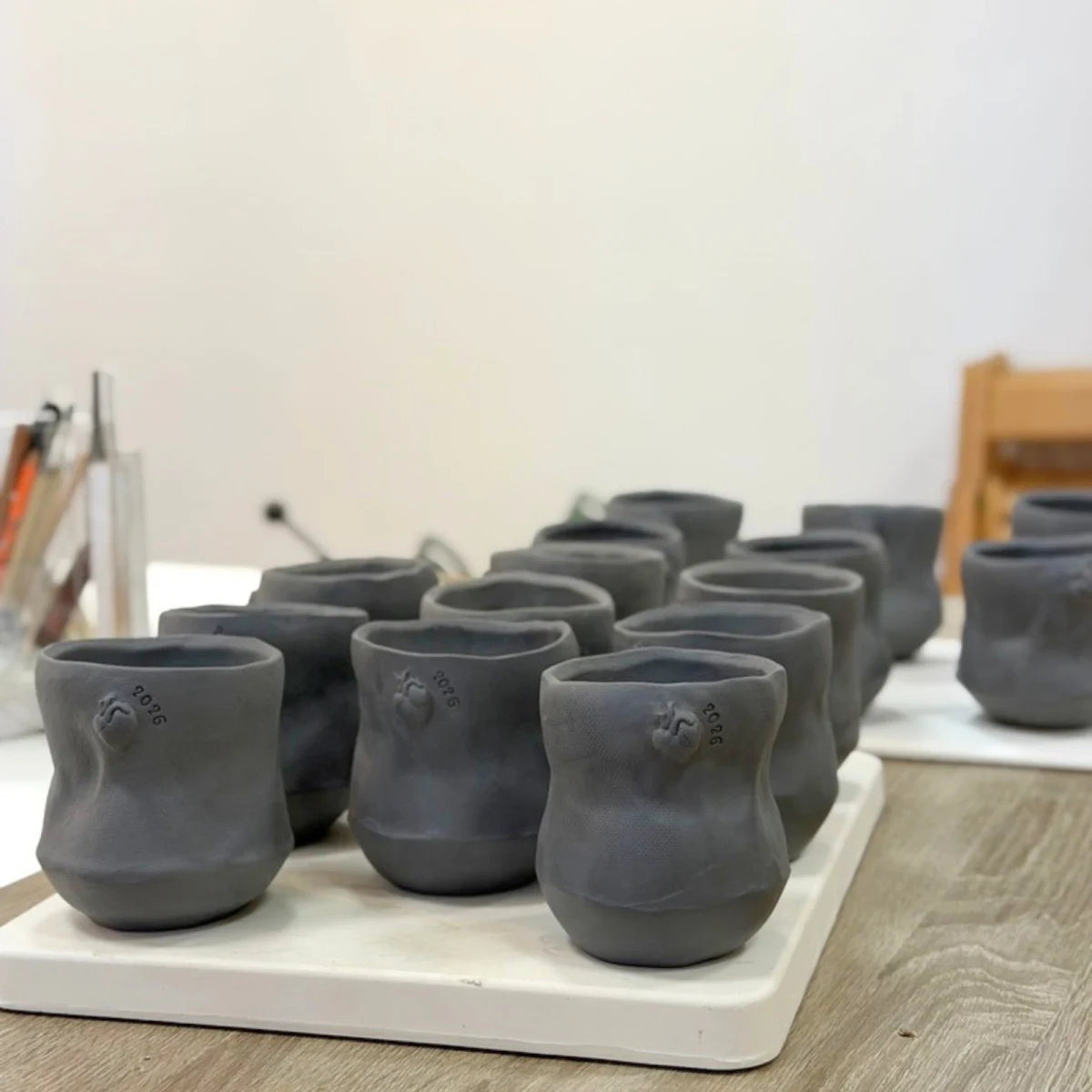
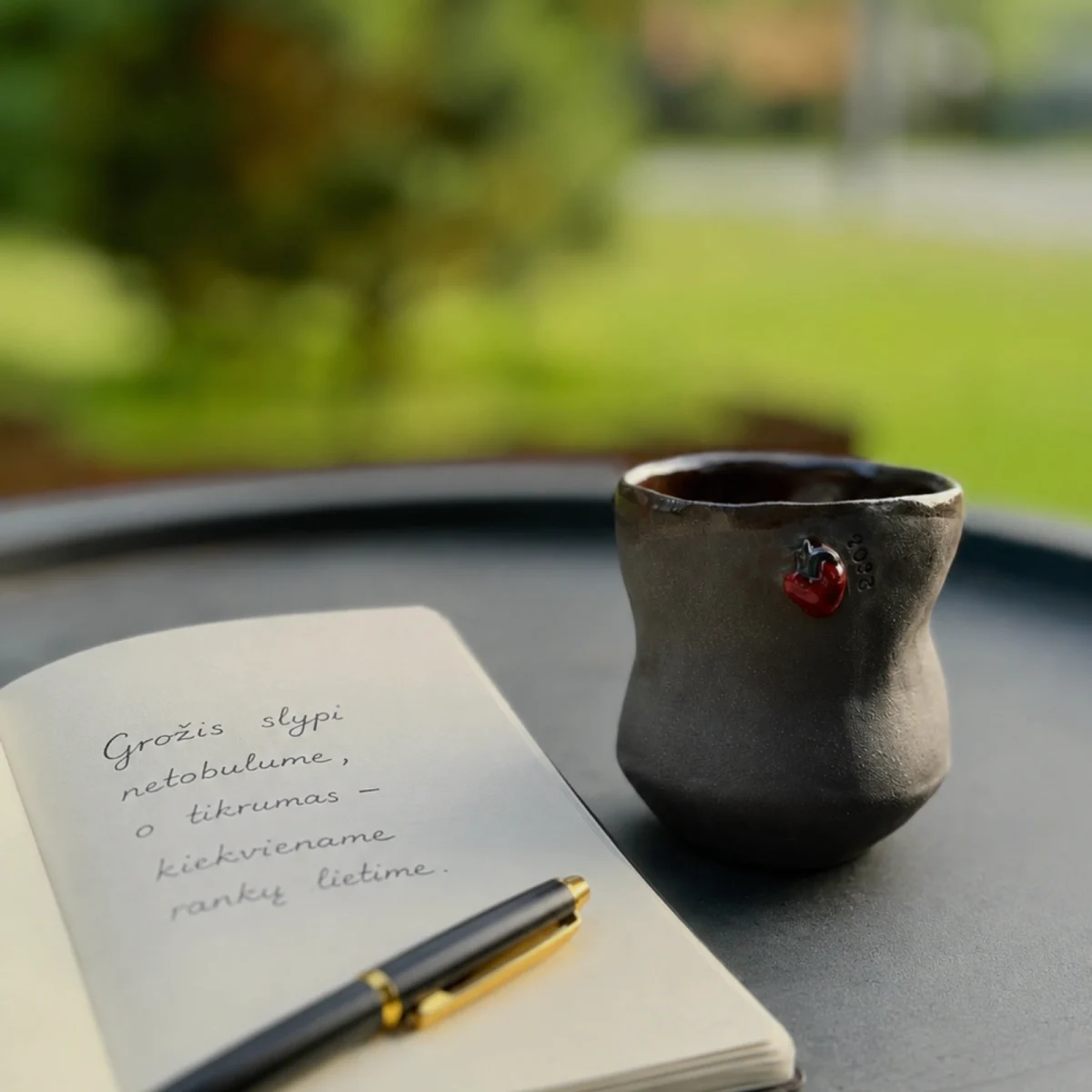
Handmade mug is a small investment in many warm mornings and many good tastes. It is an object in which the elements of nature meet – earth, water and fire – together with the warmth of the maker's hands. Take your time choosing, and this small work of art will become a faithful companion in your everyday life, reminding you each time of the beauty of the moment.
Wishing you long-lasting discoveries,
Ramunė
Hamer, F., & Hamer, J. (2015). The potter’s dictionary of materials and techniques (5th ed.). Bloomsbury Academic.
Visuotinė lietuvių enciklopedija. (2025). Kraklė. LNB Mokslo ir enciklopedijų leidybos centras. Available at: https://www.vle.lt/straipsnis/krakle/
The Clayhouse Potters. (n.d.). Stoneware vs porcelain: What’s the difference? The Clayhouse Potters. Available at: https://theclayhousepotters.com
Digitalfire. (n.d.). Ceramic materials and glaze defects database. Digitalfire. Available at: https://digitalfire.com
Lakeside Pottery. (n.d.). Are matte glazes food safe? Lakeside Pottery Studio. Available at: https://www.lakesidepottery.com
Porcelain by Antoinette. (n.d.). Cracking and dunting of porcelain mugs. Porcelain by Antoinette. Available at: https://www.porcelainbyantoinette.com
Deneen Pottery. (n.d.). Why ceramic mugs make coffee taste better. Deneen Pottery. Available at: https://deneenpottery.com
Ceramic Arts Daily. (n.d.). Community forums: Discussions on porcelain and mug design. Ceramic Arts Daily. Available at: https://community.ceramicartsdaily.org