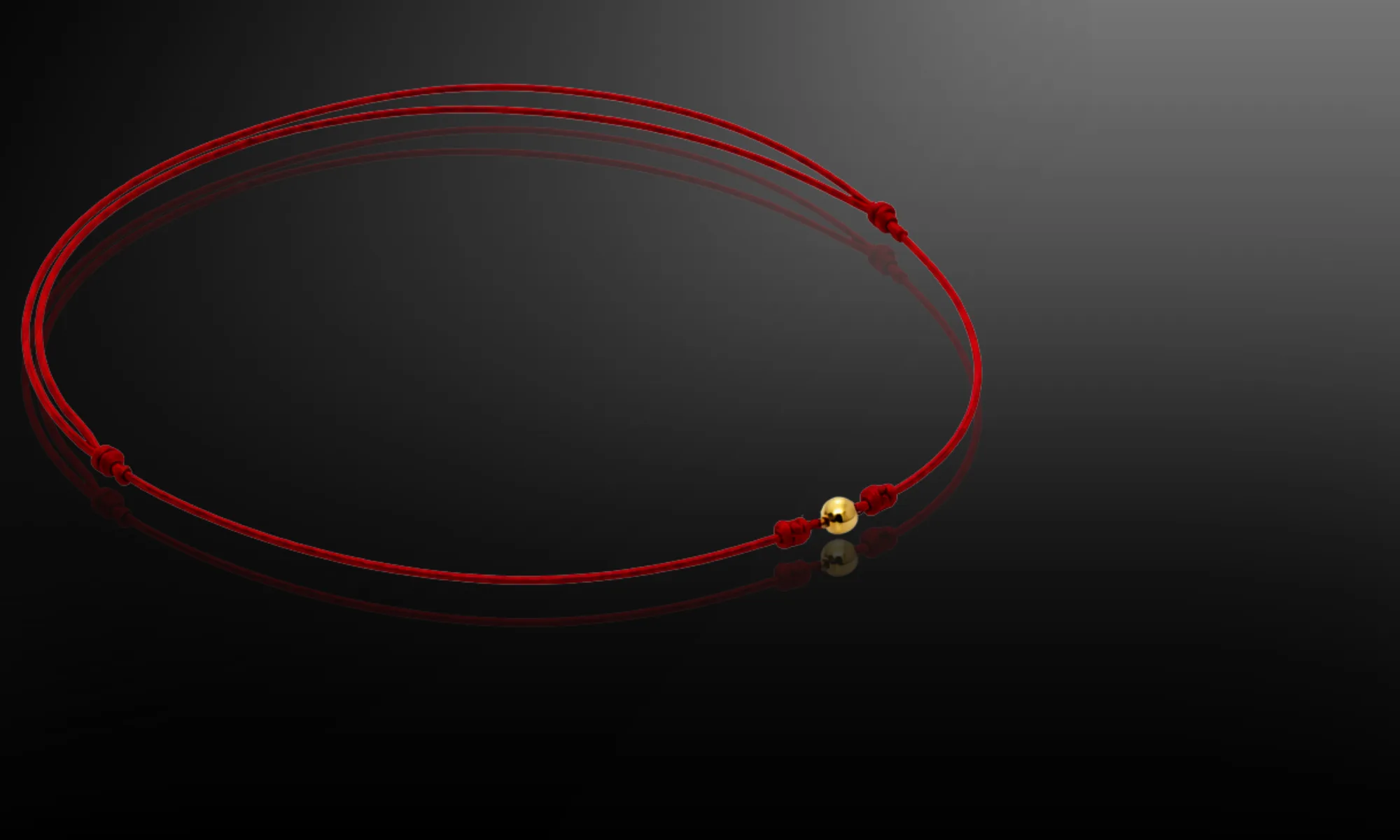

A red thread on the wrist turns up in almost every jewelry shop. Yet its history holds a great many curious details that we rarely stop to think about.
So do we actually know what this piece means? The answer often sounds rather superficial: something about protection from the evil eye. And if we asked a passer-by in the street where it came from, what its origin is, we would be unlikely to hear a correct answer. Kabbalah? That is one possible answer, but only part of its layering.
The red thread is not the story of a single ornament that became an amulet. It is the story of how, in different cultures, the simple act of tying a thread becomes a gesture that strengthens an emotional bond between people. And protection here is only one of the things it bears witness to.
One thread: three layers
This story is not only about the red thread, and not even about one self-contained piece of jewelry. It is made up of three layers, and, most importantly, they are not continuations of one another.
I. We can speculate about the prehistory. The custom of tying red wool is recorded in the medical texts of ancient Mesopotamia, protecting a pregnant woman from bleeding and miscarriage. In late antique Egypt the red thread is already an everyday object, and in the 4th century a bishop of Constantinople is indignant at parents who entrust a child's safety to a red thread. And to what else could a child's protection be entrusted in those days? [author's note].
II. The thread appears in Hebrew texts. The red thread is recorded in the Bible as well, only not as a sign of protection. The Book of Genesis says that a midwife tied it on the hand of one of the twins so that it would be clear which one had appeared first. And the custom of tying a red thread on the body appears in Jewish writings first of all in a list of prohibitions, as something foreign.
III. The red thread today. The present wave of its popularity is quite young. It spread at the beginning of the 21st century, when it began to be worn by Madonna and Demi Moore, and the Los Angeles Kabbalah Centre started distributing it as its own sign. No reliable Jewish source supporting this custom has been found.
This gives good grounds to say that the custom of the red thread has no single, clearly traceable origin, and that the form widespread today is not a direct continuation of the old Kabbalistic tradition.
And do we have anything similar?
Yes. And here begins the interesting part, the one we rarely get to hear about.
The red woolen thread really does exist in the Lithuanian tradition, and it is tied precisely on the hand. Only not against the evil eye. In the collection of Lithuanian verbal charms it appears in the healing of grižas, nikstas and girgždėlė, that is, joint pain, a sprain and creaking joints. In Zarasai this was recorded: "They tie these little red threads on the [hand] [the word 'hand' is not in the folklore record; it was inserted by the compiler of the collection, D. Vaitkevičienė]. They tie nine little knots. The arm hurts so badly" (p. 120). In the Švenčionys area the instruction is to tie a red homespun woolen thread with twenty-seven knots. In the Anykščiai area the thread is also wound around the arm three times. And in the Zarasai area it is tied when the sun is rising or setting.
The numbers are not accidental: nine, three times nine, twenty-seven. The oldest description of such counting was published back in 1846, and it already sets out the whole formula of the custom: a red woolen thread, twenty-seven knots, counting in a single breath, winding around three or nine times.
The knots are counted aloud, most often in the opposite direction, from nine down to one. And this is not accidental: this is how the whole group of charms of this kind works, in which the illness is simply counted down to nothing. It sounds like a return to the point when the person was still well.
And one more detail. The thread is not worn all the time. One record says not to take it off until the arm heals; another says that grižas [joint pain] lasts only until the thread itself falls off the arm.
An important detail: who ties it
The most important detail opens up yet another layer of this custom. The collection stresses several times who may tie it: the oldest or the youngest child in the family, and better still, an only child. "The one to untie grižas must be the oldest or the youngest member of the family, better still an only child" (p. 49).
The person does not tie it themselves. Someone else does.
In life today this custom has changed, yet its essence, passing on a certain intention to another person, has remained, and it is easy to recognize. The gesture performed today is almost the same, only the reason is different. In the Lithuanian tradition what matters is not closeness but position in the family: the one who may tie it is the one born first or last, because such a person is credited with the power to speak charms. In today's context, in the face of a society grown distant, closeness takes on a far more significant role.
It is the same custom, only, as the times changed and society met other challenges, it took on a different meaning. It seems to me that it is precisely because the meaning of the custom shifted that this piece of jewelry became acceptable in Lithuania. There are no reliable sources proving this, but it is reasonable to suppose that the foreign symbol did not seem entirely foreign to us, because a thread on the hand, tied by another person, existed in the Lithuanian tradition long before the first pieces of this kind appeared in shop windows.
The evil eye
The evil eye does not mean that "someone looked at you and something bad is bound to happen to you". It is connected with envy and with what it means to be noticed by an envious eye.
In the Lithuanian tradition this is very clearly tangible, and it is interesting that people defend themselves against the evil eye not with an object but with a word. Praise is considered dangerous, and so it is denied. When someone says, "What a beautiful child you have", the answer is: "A beautiful child, only not for you!" And the child itself is to be kept in the dark, its little eyes covered with a kerchief, so that it would not fall under the evil eye.
Here a paradox appears that we hardly notice today: if the red thread is meant to protect from an ill-wishing gaze, why is it itself so bright and so easy to notice?
Why red?
The answer is simpler than one might expect: red is the color of blood. That is why it appears wherever life and its boundary are spoken of.
What is surprising is that in the Lithuanian tradition this color is given a far broader meaning. Daiva Vaitkevičienė writes that red was once linked with beauty, health, life and vigor. As the saying goes: "Where it is sweet, it is tasty; where it is red, it is beautiful".
From this we can understand that it is not that "red means protection", but that it keeps appearing wherever a boundary needs to be marked: between the healthy and the ailing, between one's own and the foreign.
Why a thread and not gold?
Why was the cheapest object imaginable chosen for protection — a thread, rather than gold or a stone?
In the sources this can be read only intuitively, and I have not come across a direct explanation, so the arguments that follow are rather hypothetical.
As we already know, the thread should be tied by another person, so the gesture is about a relationship between two people. The thread is tied with a knot, and tying a knot is an action that can be counted and that remains visible. A thread wears out. It frays and finally breaks, and we know this even before we tie it. That is why impermanence is encoded in this gesture.
Impermanence is not a flaw here. In the charms the thread is worn only until it falls off by itself, and no longer. An amulet that never wears out promises nothing. A thread promises only as much as it can keep.
Kokie klausimai liko neatsakyti?
Which hand should the thread be tied on?
Today we often hear that a red thread bracelet should be tied on the left hand. Yet books and articles describing Lithuanian customs say that the thread is tied where it hurts, without distinction of sex or age. And what to do when it breaks? Nothing, because it was meant to break.
Another common question: can the thread be tied on a child?
Yes. But here it is worth pausing and asking what age of child we have in mind. If it is a small child, what matters is not the symbolism but safety, and this is not excessive caution. Medicine describes a separate phenomenon known as a thread tourniquet: a thread wound around an infant's finger or wrist cuts off the blood flow, and the usual culprit is a loose thread from a mitten. The average age in such cases is about five months, and the injury can develop within a few hours. ASTM F2923, the standard for children's jewelry, notes separately that jewelry is not recommended for children under three without constant adult supervision, and it deliberately sets no requirements for small parts, since these are regarded as inherent to jewelry. So for a small child the thread must break easily, and better still if the sign is worn off the body: a red thread can be sewn into the inside of a garment. Pins are best avoided, and cords and drawstrings in the neck area of children's clothing up to the age of seven are not permitted by the EN 14682 standard either.
And finally, can you tie it on yourself?
You can. Only then it is not the object that changes but what made it meaningful. Both the older and the more recent sources recording this custom state that the thread is tied by another person. When we tie it ourselves, this relationship changes: the responsibility for what the thread is meant to mean stays in our own hands.
If you do decide to tie the thread yourself, it is worth remembering that this piece is not only about protection. In the Lithuanian tradition red is linked with life, health, beauty and vigor, so the thread can also become a sign of inner energy, vitality and personal aspiration. Then we create its meaning ourselves: we give it our own aim, thought or affirmation. But the thread will not reach the aim; that we will have to do ourselves.
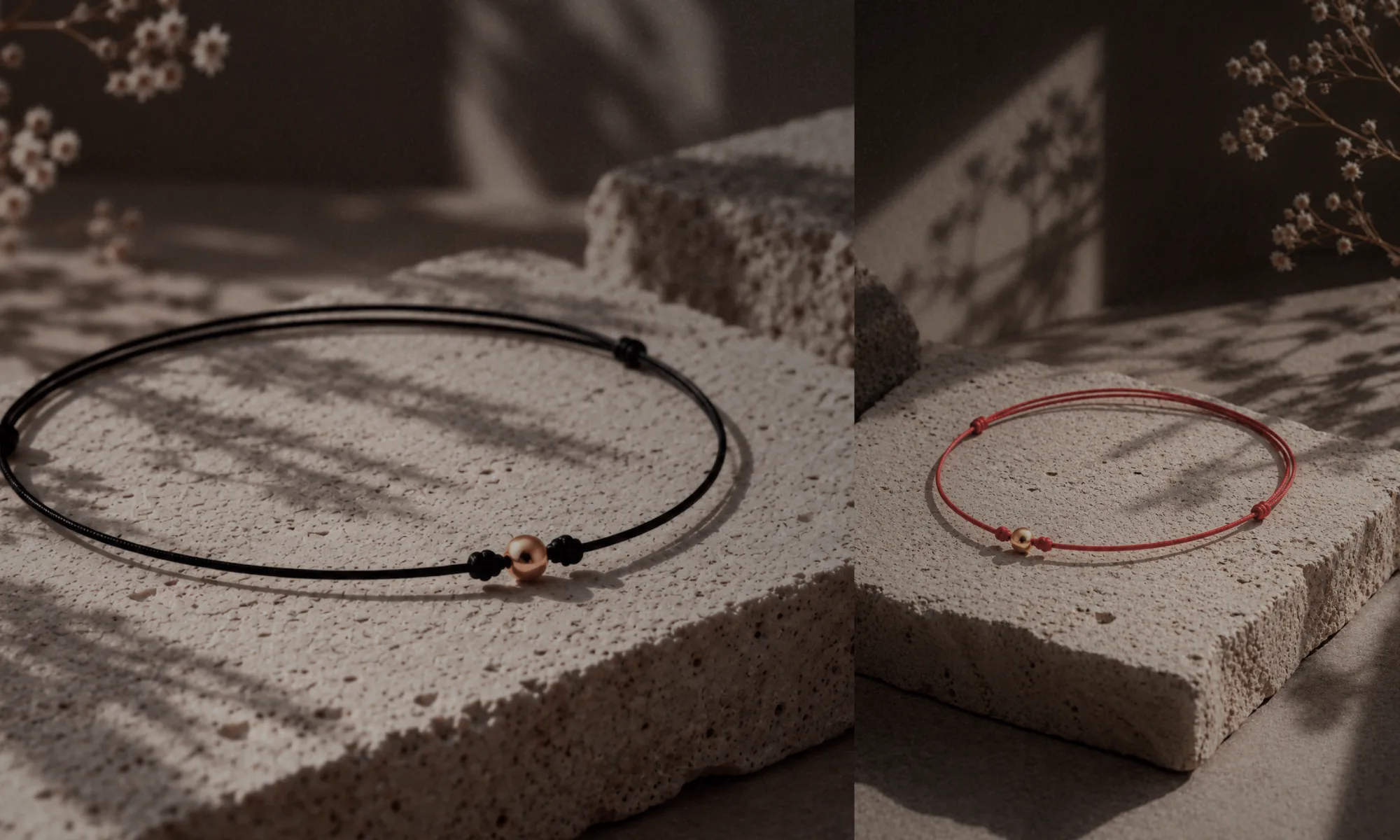
It is in response to this very thought of inner effort and direction that my collection came to include this bracelet: in it a line marks the direction, and the central point fixes the place we are trying to reach. Not a promise that someone will take us there, but a reminder that we still have to walk the way ourselves.
What is it that actually protects?
You do not have to believe in the evil eye for a red thread to mean something.
Another person's envy, the wish to diminish us, works only when their gaze finds our vulnerability. The protection of the thread works through another person: through their hands, physical touch and spiritual closeness. And what matters most here is not the object but the relationship. When we know we have someone to lean on, we become far less vulnerable to outside forces.
A red thread on the hand is not important in itself. What matters is the content and the knowledge it passes on. That is why it is not merely an object that protects, but rather a gesture by which one person gives material form to their care for another. When someone ties a thread on you, they say without words: "I will be thinking of you". That is the whole protection an object can give. The rest is not the thread's concern.
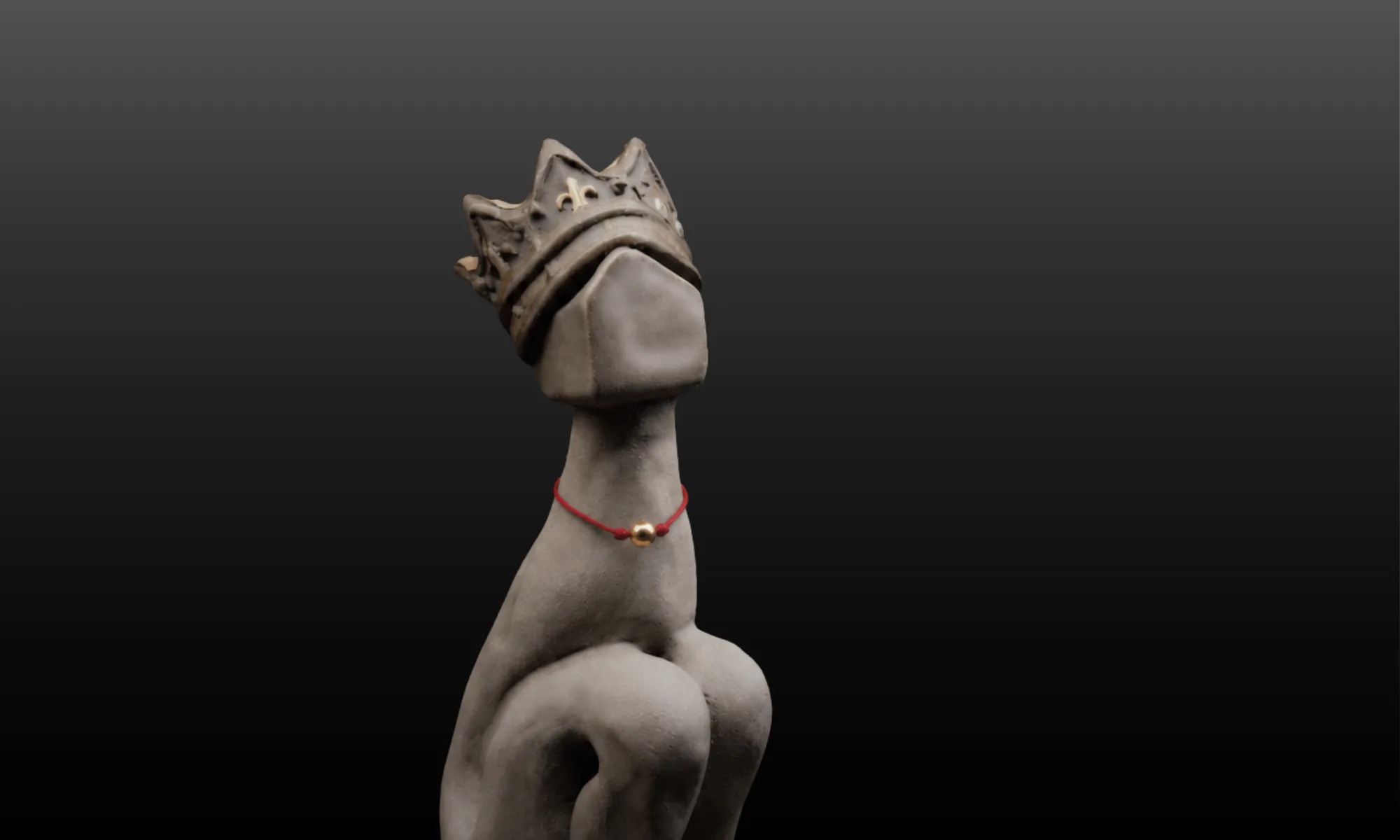
The sources say that the thread was never unambiguous or single-layered. And this understanding finally helps to answer why we still need it today. Not because it is a unique piece, but because it can become a small yet powerful sign worn every day, whose value is counted not in grams but in the marks of care that settle on the skin.
This understanding also gave rise to my own red bracelet. In it a line marks the direction, and the central point marks the person you can lean on.
- ASTM F2923-20. Standard Specification for Consumer Product Safety for Children’s Jewelry. ASTM International.
- EN 14682:2014. Safety of children’s clothing. Cords and drawstrings on children’s clothing. Specifications.
- Liebermann, R. (2022). The Protective Red Thread. TheTorah.com. https://www.thetorah.com/article/the-protective-red-thread
- Rothstein, J. (2005). Seeing red over the Kabbalah craze. Jewish Telegraphic Agency. https://www.jta.org/2005/02/17/lifestyle/seeing-red-over-the-kabbalah-craze
- Shurpin, Y. Red String Kabbalah Bracelets: Are They Real? Chabad.org. https://www.chabad.org/library/article_cdo/aid/3937562/jewish/Red-String-Kabbalah-Bracelets-Are-They-Real.htm
- Sivathasan, N., & Vijayarajan, L. (2012). Hair-Thread Tourniquet Syndrome: A Case Report and Literature Review. Case Reports in Medicine, 2012. https://pmc.ncbi.nlm.nih.gov/articles/PMC3478744/
- Stoner, J. (2018). Red threads & amulets. Roman and Late Antique Artefacts from Egypt, University of Kent. https://blogs.kent.ac.uk/egypt-artefacts/2018/12/13/red-threads-amulets/
- The Kabbalah Centre. The Red String. https://onehouse.kabbalah.com/en/articles/the-red-string-8/
- UNESCO. (2017). Cultural practices associated to the 1st of March. Representative List of the Intangible Cultural Heritage of Humanity. https://ich.unesco.org/en/RL/cultural-practices-associated-to-the-1st-of-march-01287
- Vaitkevičienė, D. (Ed.). (2008). Lietuvių užkalbėjimai: gydymo formulės [Lithuanian verbal charms: healing formulas]. Institute of Lithuanian Literature and Folklore. https://tautosmenta.lt/wp-content/uploads/2013/12/Vaitkeviciene_Daiva/Vaitkeviciene_2008_Uzkalbejimai.pdf
- Vaitkevičienė, D. (2019). Raudonas alus – baltų kultūros palikimas [Red ale: a heritage of Baltic culture]. Alkas.lt. https://alkas.lt/2019/03/03/d-vaitkeviciene-raudonas-alus-baltu-kulturos-palikimas/
With inspiration,
Ramunė