
There are festivals we travel to in order to see something. And there are festivals where you first have to change the amplitude of your gaze before you can make anything out.
“Aritmija” is exactly that kind of festival.
Over several years it has grown into an ongoing phenomenon of contemporary art. In 2026 it was held for the sixth time. The organisers describe Merkinė as a pavilion of contemporary art, and the town's terrain as the part that sets the historical narrative in context.
What interests me most is precisely this part — a town becoming a space for art. Because it fundamentally changes the usual relationship between a work of art and its viewer.
The organisers compare this phenomenon to the Venice Biennale: “The events are close to one another not in scale but in a similar construction: in Venice, as in Merkinė, art does not fit into a single hall, it spreads through the town.”
An experience that widens the gaze
Usually an event has clear boundaries. A gallery, a museum, an exhibition hall, a stage. You go in, you see the work, you leave. Even if the objects speak very strongly about a particular place, the space in which they are presented often stays fairly neutral.
In “Aritmija” everything is different.
It is not only the festival programme that grows; the involvement of the town itself expands. Ordinary and entirely unexpected spaces become temporary stages for acts of art.
In 2026 the participants presented their work in the Sawmill and in the building of a former boarding school. Exhibitions made themselves at home in the AIBĖ shop, in the “Šalcinis” gallery, in the culture centre. The sounds of the festival echoed through the Merkys valley and the streets of the town.
Nothing here happened in isolation. Everything entered an already existing layer of the place — its history, architecture, landscape, the consciousness of its people and their cultural experience.
So to understand this phenomenon you have to look at it not as a collection of separate acts of art but as an insertion into the life of a place that is already under way. A life in which visual art meets sound, grows into performance, turns into a living experiment and, having put uncomfortable subjects into words, disappears.
And the community? The community, drawn into a shared creative experience, becomes an inseparable part of this phenomenon.
An idea set in context
Contemporary art talks a great deal about context. In “Aritmija” it becomes not only unavoidable but physically experienced. It overlaps with the work, breaks into its geometry and does not fit inside it.
If an object is placed in a gallery, the viewer sees the work first.
When an object is moved into a different kind of space, it is not only the trajectory of coming to know it that changes. The very situation in which it exists changes as well. The work inserts itself into the rhythm of the place, and the place begins to act upon the meaning of the work. And often it is no longer clear where one ends and the other begins.
I felt this most strongly when I stepped into the Sawmill building.
The Sawmill is not a decoration for the festival. It was not made to look authentic. It is still alive and working. During the festival the main stage and the gallery alley were set up inside it, and right beside the stage I found the space given to my installation. I called it the V.I.P. space, but joking aside, that space tossed an obligation my way — to do what I had not even known I was capable of.
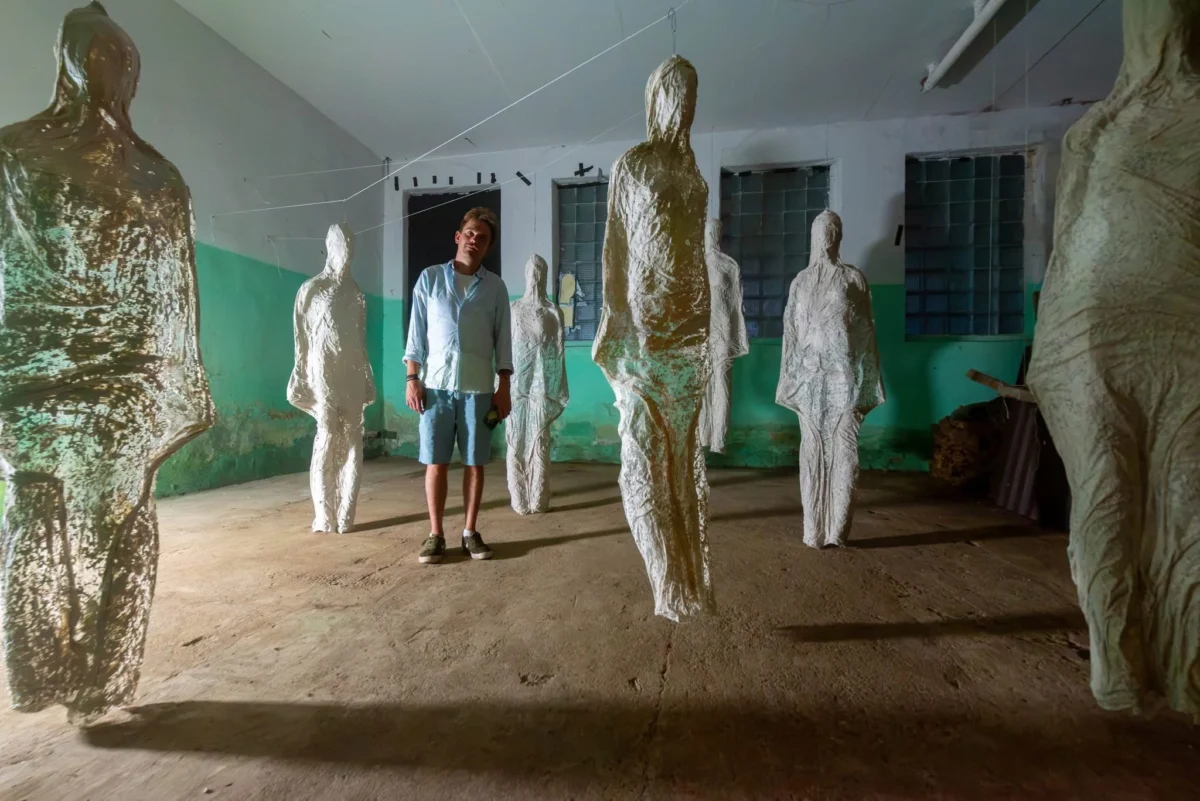
Photo: Tomas Terekas
It seems to me that this overlap played the most important role in carrying the idea through. In the same space — music, smiling people, elation, light.
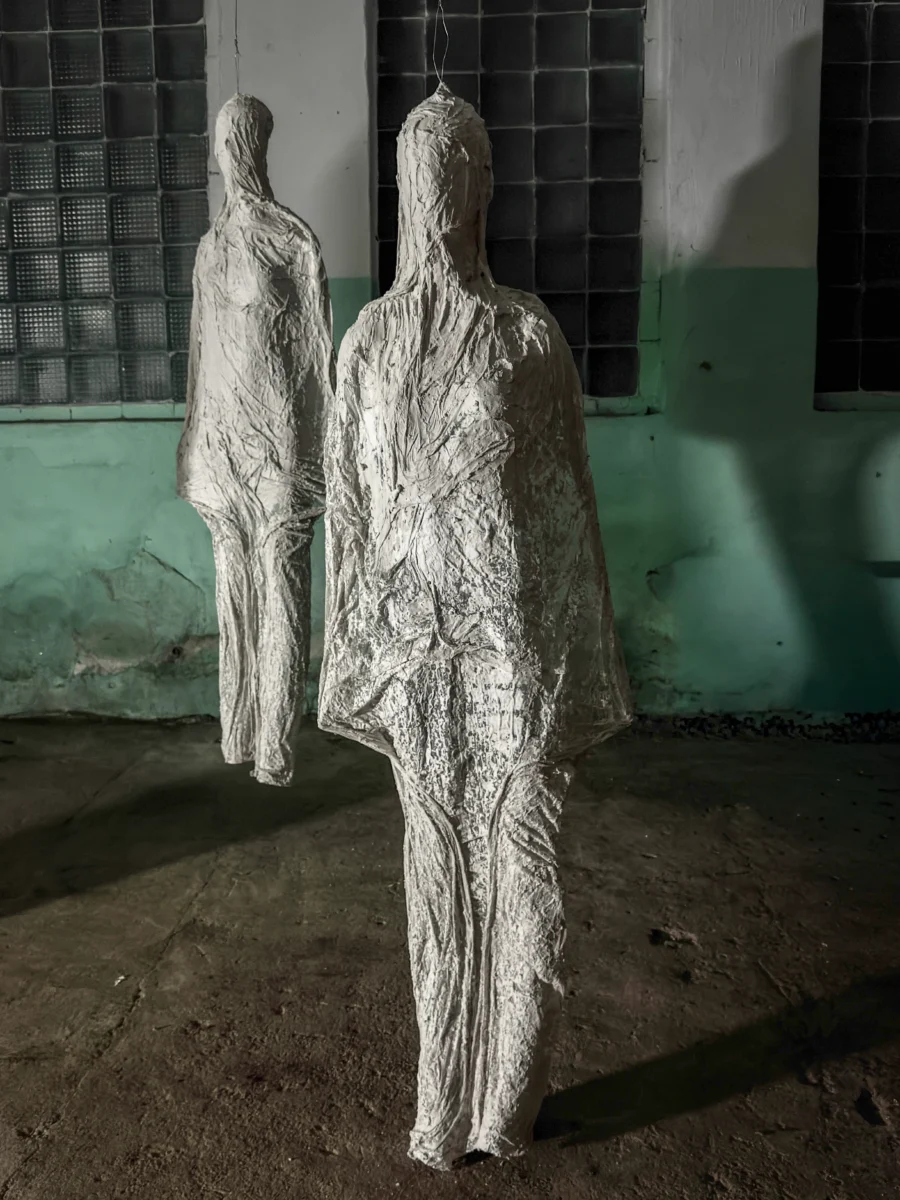
And across the threshold right beside it stand plaster silhouettes that toss out, like an affront, human vices, the drift toward comfort, conformity, smallness and the urge to cover that smallness with power — an allusion not to a person but to what is left of one.
Faceless, emptied and made alike. They stand quietly. They seem to do nothing. They simply are. But once you come closer you feel the discomfort of your own shell.
Experiencing “Aritmija”
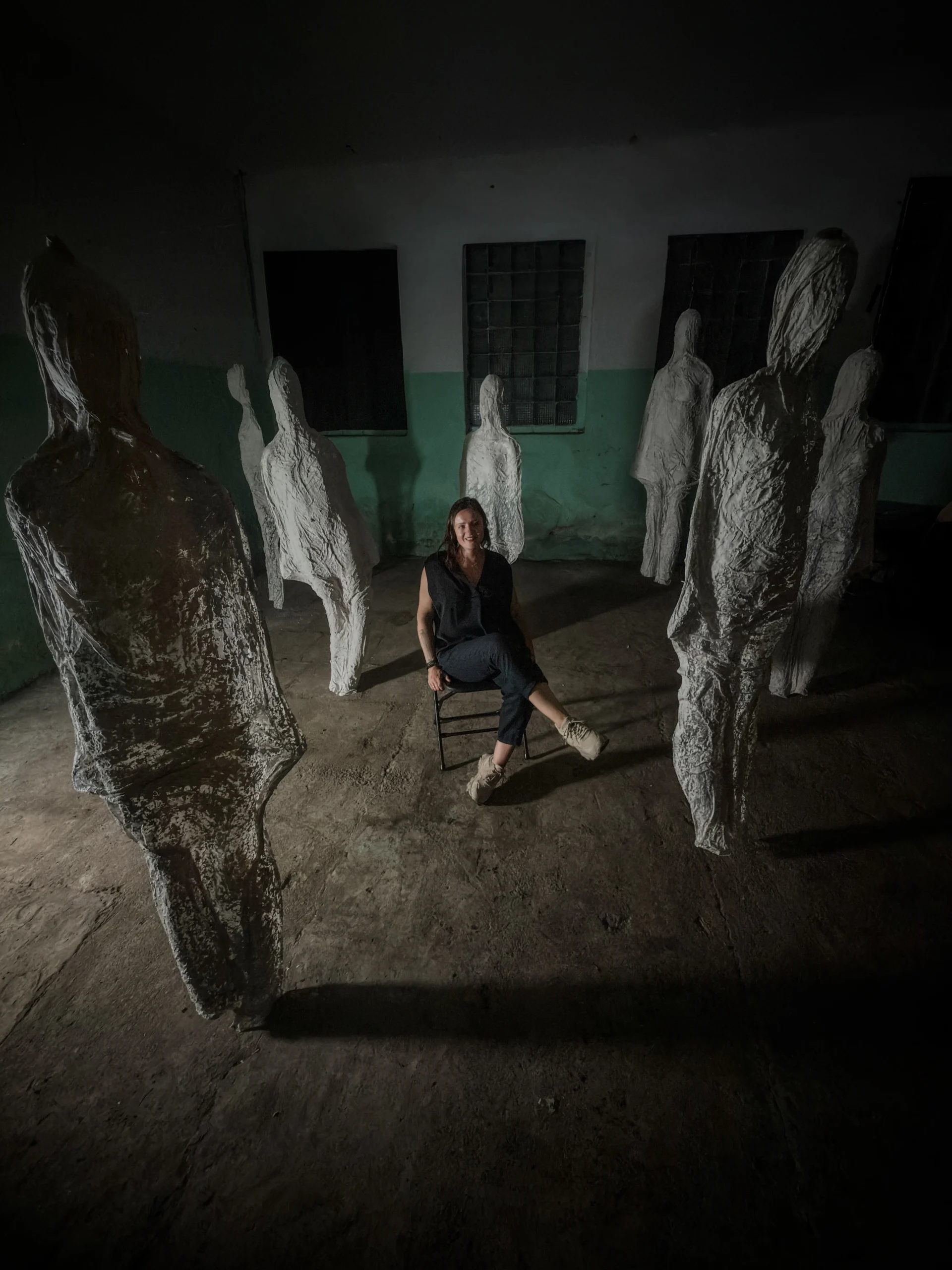
In 2026 at “Aritmija” I presented a large-scale installation, “Shells”.
The installation consisted of human silhouettes. These were not portraits of particular people. The figures had no individual faces, no clear characters, no specific stories. Their purpose was to reflect the trace of a human presence — a body of which only the outer layer remains.
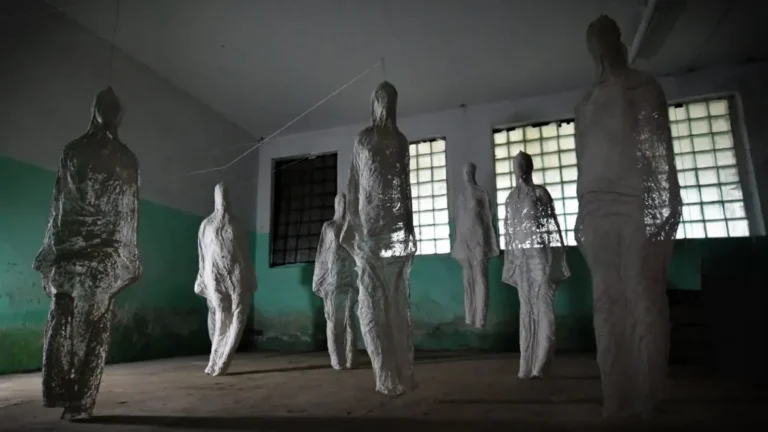
What mattered to me in the work was precisely this indeterminacy. What remains when we no longer remember a name, a face, a story?
The body becomes a shell.
But in the Sawmill this question took on a different shade than it could have taken on in the neutral space of a gallery.
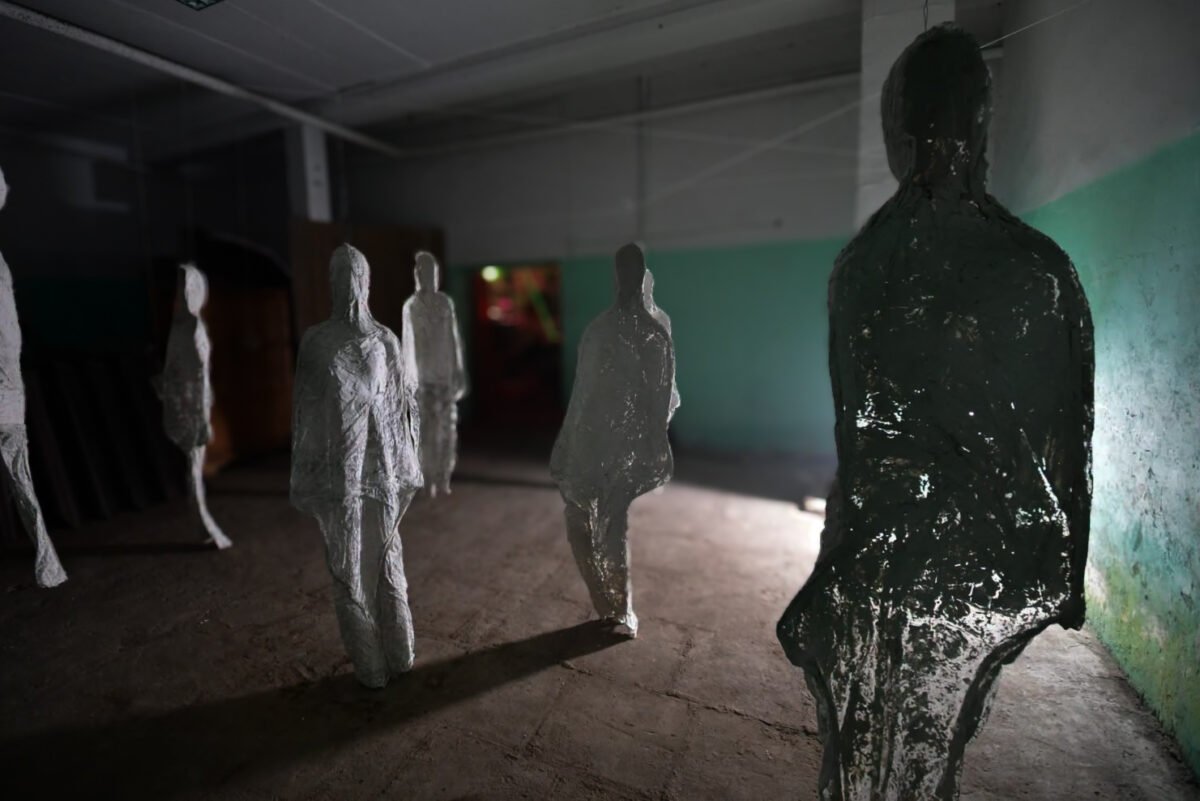
The space given to the installation was right beside the main festival stage. Behind the wall and a few metres from the figures the life of the festival was going on — music, people, movement, emotion.
And “Shells” seemed to be waiting to meet that vitality. For me it became a very strong contrast. A living, working building. A stage. Sound. Lights. People. Their feelings and their experiences.
Suddenly the silhouettes were no longer only silhouettes in themselves. They found themselves in a place where life itself inevitably comes close.
And then I understood that “Shells” speaks not only about a person. It speaks about a place as well.
About how a layer of memory appears beside everyday life. And this is the moment when the meaning of a work starts to depend not only on the author's intention. Or more precisely, it goes on to outgrow it.
Where trajectories intersect
In the installation the figures were arranged so that people could move between them. I wanted the viewer not to be only an observer. But to experience the work directly. And I think the space helped me carry this intention through. In a certain sense the work surrounded whoever entered it.
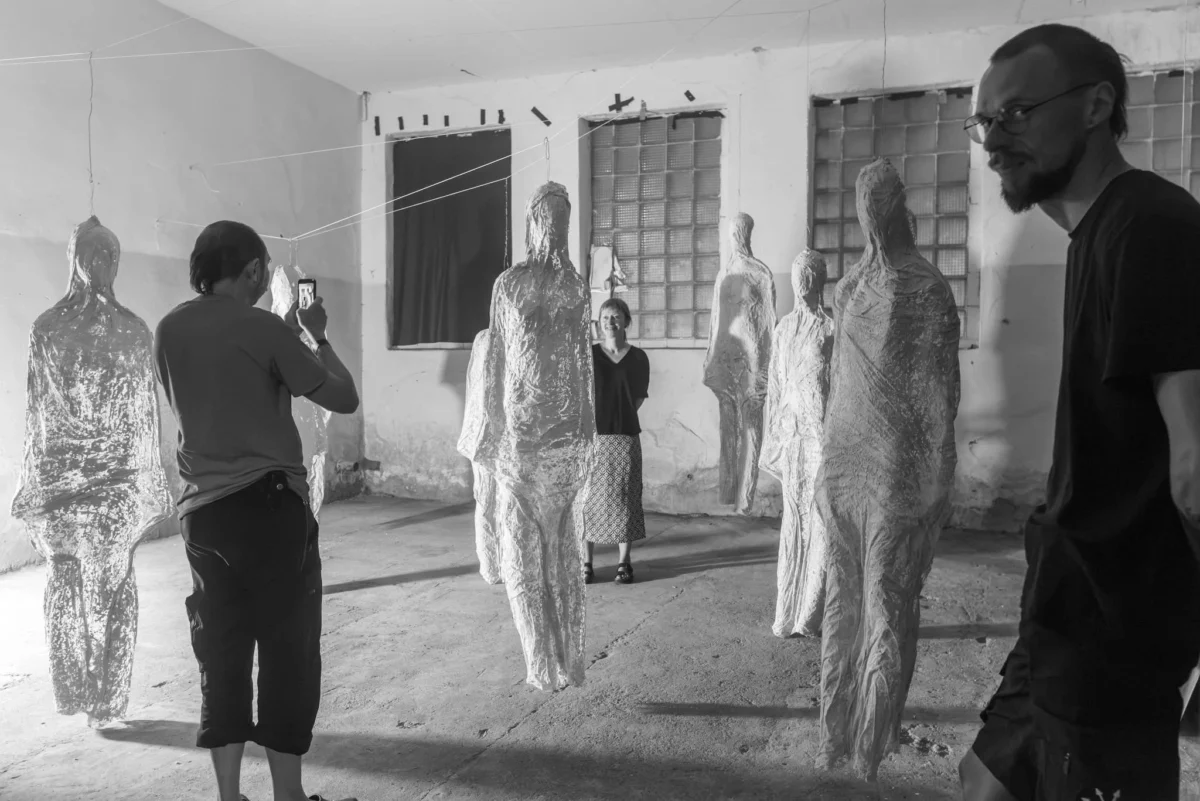
Photo: Tomas Terekas
Because it is impossible to experience the work from the side, just as it is impossible to know Merkinė from a single vantage point. You have to move. From one place to another. In order to discover. To feel. To be left at a loss.
And most importantly…
You are still never quite sure whether what you are seeing is a work, festival infrastructure, or simply Merkinė itself.
And so “Shells”, through this setting in context, became not an isolated object but a living experience. And the most important thing was that I did not have to stage the act of settling in. Because the living cultural process was flowing right beside it, in its own natural course.
Shifting perimeters of perception
One more important question has to be raised. Why does a contemporary art festival take place in Merkinė of all places?
Not in Vilnius. Not in Kaunas. Not in a space built for art.
The festival's official communication states the answer clearly enough: to strengthen the link between the metropolitan art scene and the region, to promote professional contemporary art and to widen the geography of cultural centres.
This is an important question of cultural policy, and in “Aritmija” it takes a practical rather than a declarative form.
The artist has to travel to the region. The viewer also has to travel to the region. The work has to adapt to the place. And the place itself has to accept what was not there before.
But the Sawmill opens up a fact that changes one's understanding: a place does not have to stop being itself for art to settle into it.
The Sawmill did not become a gallery. It remained a sawmill, with stacks of logs leaning against the walls. Its own purpose went on existing there, even though the festival organisers put up a stage inside it, gave the works a place to live, invited an audience and widened the perimeter of what it is for.
So this is not a one-way “bringing in” of culture, nor is it merely an exchange between two sides. Art that inserts itself works differently: it enters a system already in place and briefly changes the rhythm in which that system works. The place does not become a different place because of it, but what used to be ordinary in it begins to be seen differently. It is precisely this temporary tension between the work and the place that was, it seems to me, my essential experience of coming to know “Aritmija”.
Does art have to be comfortable?
It is important to talk about this, because art that inserts itself is never neutral.
A contemporary work opens up differently to different people: to one it says something at once, to another it stays closed, to a third it seems unnecessary in that particular place. It seems to me that this is not a weakness of the “Aritmija” festival. In a certain sense it is a natural consequence of the aim it has set itself.
If contemporary art comes to a place with no usual contemporary art infrastructure, it inevitably meets the question:
who is this art for?
And more importantly:
who has the right to decide what art is in a particular place?
This question is not comfortable. But from the point of view of cultural research it is very valuable.
Over six years “Aritmija” has grown from an event into a phenomenon that can now be identified without difficulty.
The range of participants, art forms and activities in the programme keeps expanding. But the importance of the festival lies not only in the scope of its programme. What matters most are the changing relationships and the widening geography of a cultural phenomenon.
What remains when the noise dies down?
The festival has ended — the festival begins. After the festival the installations are dismantled. The music falls silent. People disperse. Merkinė goes back to its ordinary life.
But it seems to me that this is exactly where the most interesting part of “Aritmija” begins. Because the value of a festival should not be measured by visitor numbers or by the scope of the programme.
One has to ask what remains when the noise dies down.
Does a new relationship with the space remain? Does a person walking past the Sawmill the next time remember what they saw inside? Does the artist, back in the studio, bring home not only the experience but also a new relationship with their own work and even with themselves?
The name of the festival — “Aritmija” — is not accidental.
The curator Algimantas Rokas Černiauskas explains it as a reference to a disturbed rhythm — a step out of the usual cultural, social and natural beat.
But this disturbance can also be understood as the working principle of inserted art itself. A work does not change a place and does not take it over. For a while it joins the rhythm already running there, creates friction and lets us see what had gone unnoticed until then. This is why “Aritmija” matters not only because art appears in an unexpected place. What matters more is that art which inserts itself changes our relationship with that place.
With warm wishes,
Ramunė