

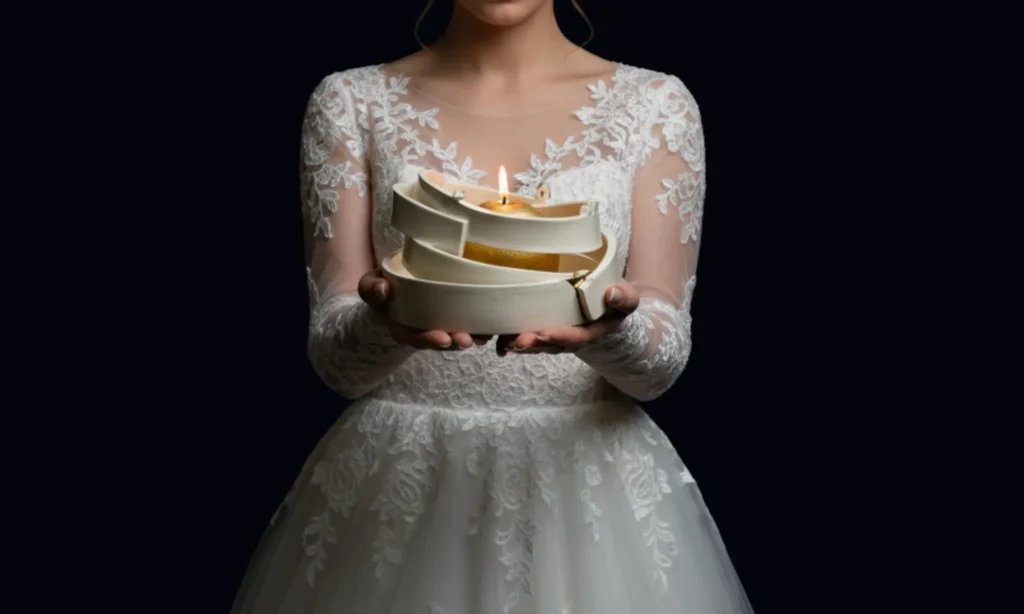
A family hearth is a symbolic wedding gift for the newlyweds, one that after the celebration becomes a homely ritual and a symbol that gives meaning to memories.
Let's try to put into words the moment when the family hearth is lit for the first time in the house, and the young people look into the fire together? At that moment, hope burns in their eyes, and in their hands - their own future and its vision.
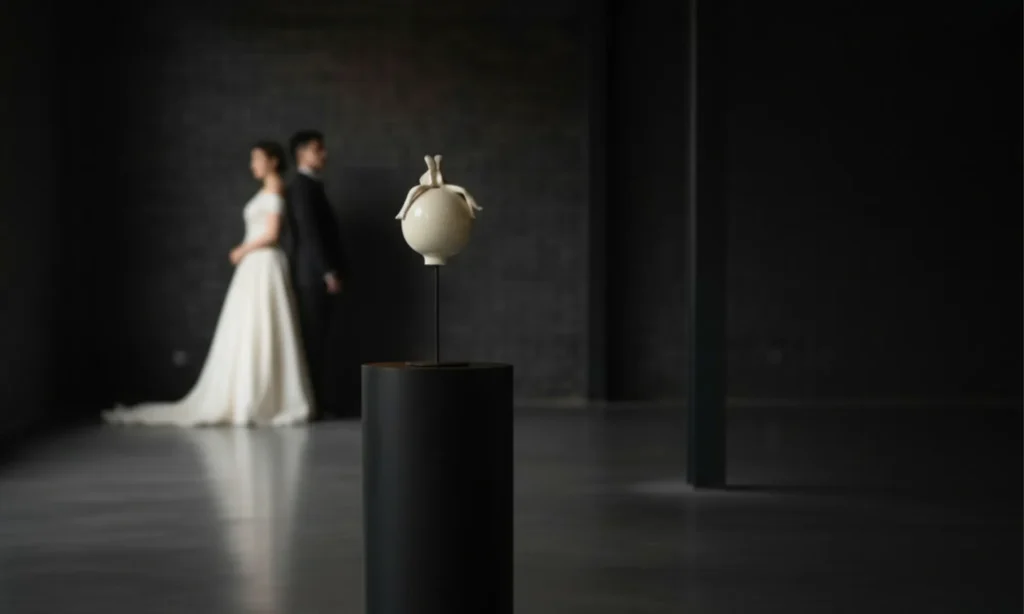
What is the family hearth?
The family hearth is a sign of the center of the home. It becomes truly valuable only when the story of two people is placed within it, a promise to one another, and in the wedding ceremony it also means that from now on two families become one.
When you think of a family hearth, you feel as if you are thinking of a gentle yet vibrant heartbeat. It is not just a symbol or an old tradition. It is a sign that connects us to the past, to the hands of our ancestors, who once created a connection and taught us to cherish it. The family hearth is a pure source of light that does not run out as long as we nourish it with our love, care, and communion. When passed on, the hearth becomes a bridge between two families – the young and their parents. It is a gift that has no material value, but is like a promise – to never abandon the hearth that unites the family.
The meaning and symbol of the family hearth
The family hearth symbolizes the power of eternal fire. It is the core of all our identities. Fire is the flow of life, and the hearth is its symbol in the home. The ancient Balti considered fire sacred, and each family member knew that the fire that warms the home is not only physical, but also spiritual – the one that provides security, peace, and unity. Therefore, fire during a wedding becomes a special symbol, testifying to the beginning of a new family – bright, strong, and saturated with love.
Today, as in ancient times, fire is a bridge that connects us to the past, to our roots. And even if it sometimes seems that modern life is moving away from ancient traditions, this fire burns within us, reminding us of essential values: love, respect, care and loyalty to our neighbor, to our identity.
Family hearths for weddings – the most significant gift
When we start talking about weddings, we think not only about the celebration, but first of all, the feeling that arises before us, which, thanks to traditional rituals, is shared by the newlyweds and their loved ones. The family hearth is like a secret language that only those who love and care for each other understand. It is a gift that does not lose its meaning over the years.
Could we describe the moment when the hearth is lit for the first time in a new home, and the young people look into the fire together? At that moment, hope burns in their eyes, and their own future in their hands.
The family hearth is not only a gift, but also a commitment. A commitment to create, nurture, and protect together what is most important – love and family, spiritual harmony, which they will pass on to their children. It is an obligation to never extinguish what their parents and ancestors created. It is a thread with the past that allows us to move forward, strengthen our roots, and be constantly warmed by the same flame full of love and respect for each other.
In today's wedding celebrations, traditions are often transformed, but their roots remain vibrant.
Family hearth for newlyweds - what does it mean to them?
For a young family in today's world, where everything is changing at an unimaginable speed, it is important to have something that would bring them back to themselves, to the beginning, where it all began. The family hearth is perfect for this. It is that harbor of peace that reminds us that the most important thing is not technology, not world news, but what we can create together. This is the world we have created, where what is real and irreplaceable is born.
Today, the family hearth for newlyweds is becoming not only a beautiful part of the wedding ceremony, but also a powerful symbol that they can rely on. Knowing their cultural roots, young people realize that their relationship can be as strong and permanent as the fire they protect. Fire brings warmth and light, but at the same time it reminds of responsibility - because without a mutual commitment to care for each other, even the most beautiful things can fade over time.
The importance of the Baltic cultural tradition
Many sources emphasize the importance of fire and hearth not only in ancient Lithuanian, Baltic, but also in other cultures. The family hearth is closely connected with Baltic mythology, where fire was perceived as sacred. The hearth in the house was not only a place where food was prepared, but also a sanctuary through which a connection with the gods was maintained. It is a place where a smoldering fire brings blessings to the family, protects it from misfortunes, therefore the symbolism of the family hearth, even in modern weddings, does not lose its relevance - it is not only a symbol of warmth, but also of security, divine protection and blessing.
The ritual significance of the family hearth
Historical sources often mention that the family hearth was an integral part of wedding ceremonies. Sometimes the fire was brought from the parents' house to the newlyweds' new home, thus symbolizing the continuous vitality of the family hearth. This tradition shows a deep emotional and symbolic connection between generations. The transfer of the family hearth is like an oath to continue the traditions of the family, to build a family based on the same values.
We find the same care far beyond Lithuania. The French historian Fustel de Coulanges, who studied ancient texts, described Greek and Roman customs in which fire was also sacred: it was guarded day and night, covered with ashes in the evening, and revived again in the morning by breathing life into it. Of a family that was no more, people then said that its hearth had gone out, and both expressions meant the same thing. There, too, fire lived on as long as there was someone to care for it.
Fire is a religious and spiritual symbol
According to ancient Baltic beliefs, fire was protected by deities and considered sacred. In this context, the symbol of fire becomes not only a material object, but also a spiritual connection between different worlds - the earthly and the divine. This is a strong argument, emphasizing that the fire of the family hearth is not only a tradition, but also a source of inner light, spiritual strength, which the young bring into their lives.
The Lithuanian name for fire bears witness to the same thing. The linguist Kazimieras Būga linked Gabija to the words "gaubti" and "gobti", the same ones used for the evening act of covering the embers with ashes. The name came from what a person did with the fire: everyday quiet care itself became the name of the goddess.
The connection between tradition and modernity
As Vilma Mulevičiūtė-Sabaliauskienė’s work shows, in modern weddings, traditions are often transformed, but their roots still remain alive. The family hearth becomes a bridge between the past and the present, embodying the continuity of traditions, even when the way of life itself changes. This perfectly reflects the idea that even in modern wedding scenarios, the family hearth can have a place, symbolizing the deep importance of a connection with the past, despite cultural changes and modern lifestyles and habits.
Who buys the family hearth?
The family hearth is almost always passed on by the parents. Or, more precisely: the mothers agree on it. At first this may sound like a small detail. Yet it is the most beautiful part of this gift. The hearth becomes a shared decision of two families even before the wedding. Two women, who until then might never have met, have to find a sign that can become common to both and unite their children. When the hearth is handed over at the celebration, it is already a bridge, only history tends to keep quiet about that.
These days, however, it is increasingly often ordered by wedding planners, the witnesses, or even the newlyweds themselves.
What to say when handing over the family hearth
– Until now we have kept this fire. From today it becomes your promise to one another. Keep it, may it never go out.
– We are handing you not an object, but what we ourselves have been learning all our lives. To care for one another every day, even when it seems that nothing special is happening. Fire glows not because of beautiful words, but because every evening someone stops beside it. Be each other’s support.
– The hearth will do nothing for you. But it is a reminder that the two of you alone are responsible for the life of the fire in it.
What family hearths are most popular today?
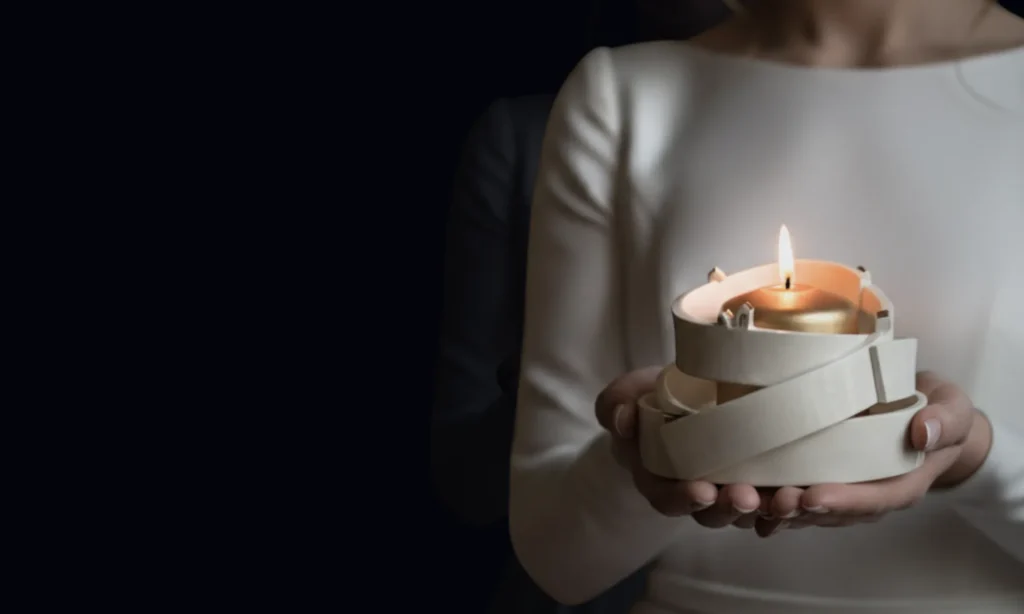
Today they vary greatly: from a restrained object with a date to a larger sculptural form. You can read about the most common choices, the typical materials and the likely prices on the family hearths page. šeimos židinių puslapyje.
1. Senvaitytė, D. 2005. Ugnis senojoje lietuvių tradicijoje: mitologinis aspektas. Kaunas: Vytauto Didžiojo universitetas. ISBN 9955-12-072-Х.
2. Trinkūnas, J. 2000. The Faith of the Balts. Vilnius: Krantai. ISBN 9986-571-02-2.
3. Mulevičiūtė-Sabaliauskienė, V. 2010. Relationship with tradition in contemporary wedding scenarios. Kaunas: Vytautas Magnus University. Online access: https://vdas.academia.lt [accessed 2024 09 16].
4. Jagelavičiūtė, R. 2021. The Meaning of Ancient Baltic Culture in Contemporary Architecture. Kaunas: Kaunas University of Technology. Online access: https://ktu.lt [accessed 2024 08 23].
5. Belonogoff, C. 1997. Customs & Traditions: the Lithuanian Wedding a Family Celebration. Vilnius: Draugas News. Available online: https://www.draugas.org [accessed 2024 10 03].
6. Sun, Y., Lo, H., Cao, J., Lin, R. 2022. Inheritance of Traditional Family Values: A Comparative Study of Family Ancestral Shrines and Related Paintings of Lee Family. Sustainability, Vol. 14, No. 12, art. 7188. Prieiga internetu: https://doi.org/10.3390/su14127188 [žiūrėta 2024 10 06].
7. Fustel de Coulanges, N. D. 1980. The Ancient City: A Study on the Religion, Laws, and Institutions of Greece and Rome. Baltimore: Johns Hopkins University Press. ISBN 0-8018-2304-8. Originalas išleistas 1864 m. Prieiga internetu: https://www.gutenberg.org/ebooks/8074 [žiūrėta 2026 08 29].