CARE OF CHAMOMILE SCULPTURES AND INTERIOR DECORATIVE ITEMS
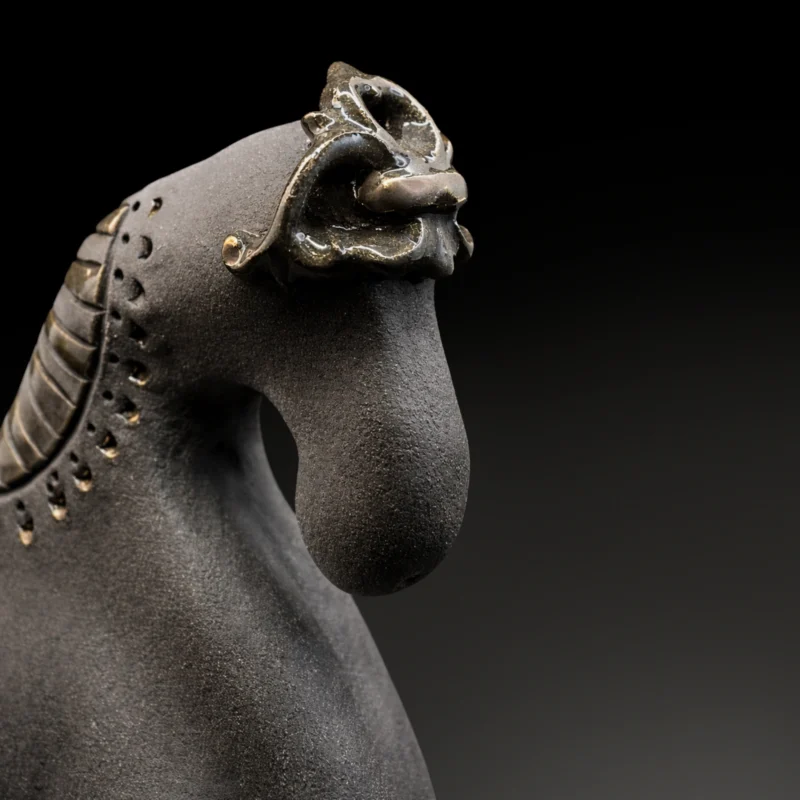
Fine-grained chamotte sculptures have a more porous and often unglazed surface, which makes them more sensitive to abrasion, to absorbing dirt and to unsuitable wet cleaning. The most important precaution is dry cleaning.Precious metal lustres (gold, platinum, palladium and similar) are a thin on-glaze layer fired at a lower temperature, so they are more vulnerable to abrasives and friction. Care for such decoration gently, by hand, without scrubbing.
MATERIAL PROPERTIESChamotte is clay that has been fired at a high temperature and ground down, then mixed back into the clay body. It reduces shrinkage during drying and firing, helps the piece dry more evenly and can increase resistance to thermal stress, especially in larger forms. At the same time it can leave the surface more porous and give it an absorbent texture, particularly where the piece is unglazed.These instructions apply to fine-grained chamotte sculptures and interior objects, often larger forms, which may be unglazed or partly glazed.
CLEANINGDry cleaning (the main method): lift the dust with a soft brush and guide it into a vacuum cleaner set to minimum suction. Do not use rough cloths, as they increase the risk of scratches and of the decoration losing its shine.Wet cleaning only in exceptional cases: washing or soaking is not recommended, especially where the surface is porous, where there are older repairs or where the condition is unclear. If it is unavoidable (for example, sticky dirt), consult a specialist first.
COMPARISON OF MATERIALS| Material | Decor | Is it dishwasher safe? | Recommended cleaning | Risks |
| Fine fraction chamotte | There is no luster. | No | Dry cleaning: soft brush, vacuum cleaner with minimum suction; wet cleaning – only exceptionally | Surface stains from grease/touch; scratched |
| Fine fraction chamotte | Precious metal luster (local) | No | Minimal contact: dry, ultra-gentle wiping | Measuring polished areas; damage to decorative coating |
Gilding/luster is a thin overglaze layer, easily damaged by abrasion and will wear away over time if not properly maintained.
LITERATURESIO-2. (n.d.).
What is grog and what is it used for? https://www.sio-2.com/gb/blog/tips-information/what-is-grog-and-what-is-it-used-forNational Park Service. (2008).
Museum handbook: Ceramics.
https://www.nps.gov/subjects/museums/upload/08-01_508.pdfCanadian Conservation Institute. (n.d.).
Care of ceramics and glass.
https://www.canada.ca/en/conservation-institute/services/conservation-preservation-publications/canadian-conservation-institute-notes/care-ceramics-glass.htmlLithuanian National Museum of Art. (nd).
Pranas Gudynas Restoration Center – activities.
https://www.lndm.lt/struktura/pgrc_veikla/




Reviews
There are no reviews yet