
Sustainability is talked and written about a great deal these days. Yet it often becomes little more than a comforting word that can be printed on a package. In ceramics, though, sustainability does not begin with a promise. It does not even begin in the studio, but with quite ordinary everyday decisions that most people never see. For me personally, sustainability begins in my head and in my choices, and only then does it reach the studio, the home, a relationship.
What matters to me is not whether I can call my work sustainable. What matters more is to keep asking myself, to remember to ask, what I could do differently, where I could use less, and how to change and improve my working process a little each time.
The material that carries the code of sustainability
I dry clay scraps and hardened clay completely, and later make a new clay body out of them. This is probably the simplest sustainable act possible in ceramics, but it is a meaningful one.
Unfired clay loses none of its properties. It can dry out and wait as long as it needs to. Wetted again, wedged and prepared for work, it becomes the same material it was before, and perhaps even better.
The change happens during firing. A fired piece will never return to being clay body again. Even that, however, is not a final verdict, because bisque (a once-fired ceramic shard) can be crushed, and the resulting “clay flour” (a caricature on my part, of course) can be wedged into unfired clay, producing a body with added particles that potters call grog.
That is why, before I put a piece into the kiln, I ask myself once more: is the form really the one I want? Is it really worth firing? Have any flaws or mistakes gone unnoticed?
Sometimes that pause is the most important stage of the work that follows.
What gives a piece its longevity?
For me, longevity in ceramics has to do first of all with how the material has been fired. This is not merely a question of opinion or aesthetics. Ceramics has a very concrete measure for it: water absorption.
Ceramics is considered vitrified when it absorbs less than 4 per cent water. The fired test piece is weighed, immersed in water for twenty-four hours, then taken out and weighed again. The difference shows how much water the material absorbed and whether vitrification was complete.
Firing temperature is crucial here. Low-firing clays vitrify at up to roughly 1 100 °C, and vitrifying clays between 1 100 and 1 400 °C.
High temperature, of course, has its price. Porcelain and grog can shrink by as much as 25 per cent while drying and firing. This means a piece can come out of the kiln, and does come out, up to a quarter smaller than it was before.
So sustainability in ceramics is not about how much material you use. It is also about whether that material has the potential to become a work at all.
Every time is different
I do not throw and I do not cast. Well, not entirely: I cast some armature forms, but everything else I build by hand.
This matters to me, because it is exactly where the difference lies between ceramic art and small-series production.
Throwing or casting allows you to make as many identical objects as you need. The form repeats. Hand-building does not work that way. Each piece comes into being one at a time, and even if I tried to make a second one just like it, it would still turn out different.
I am not entirely comfortable talking about series. There are no series here, because there is nothing to repeat: each piece is born alone. I can work on similar forms and return to the same thought, but there will be no second piece exactly like the first. Full stop.
Under the layers of paint
For me, the search for sustainability in ceramics is not confined to the working processes in the studio.
One of the projects where I felt this most keenly was the restoration of the facade decoration of Ilzenbergas Manor. At the time I still felt hesitant about calling myself a sculptor, but we only grow when we choose something uncomfortable, something daunting, perhaps even paralysingly daunting. And this project was precisely about that. I took on the challenge of recreating forms that German craftsmen had once made.
The building was there. The forms were there too. But over time they had crumbled and been repainted so many times that they had lost their depth and their precision. The petals of the rosettes had almost merged into a single surface, and the centres of the volutes had filled up with paint.
Working from photographs, I recreated those forms in clay. Using the models I made, the company that commissioned the project later cast new facade details and restored the manor's authentic ornament.
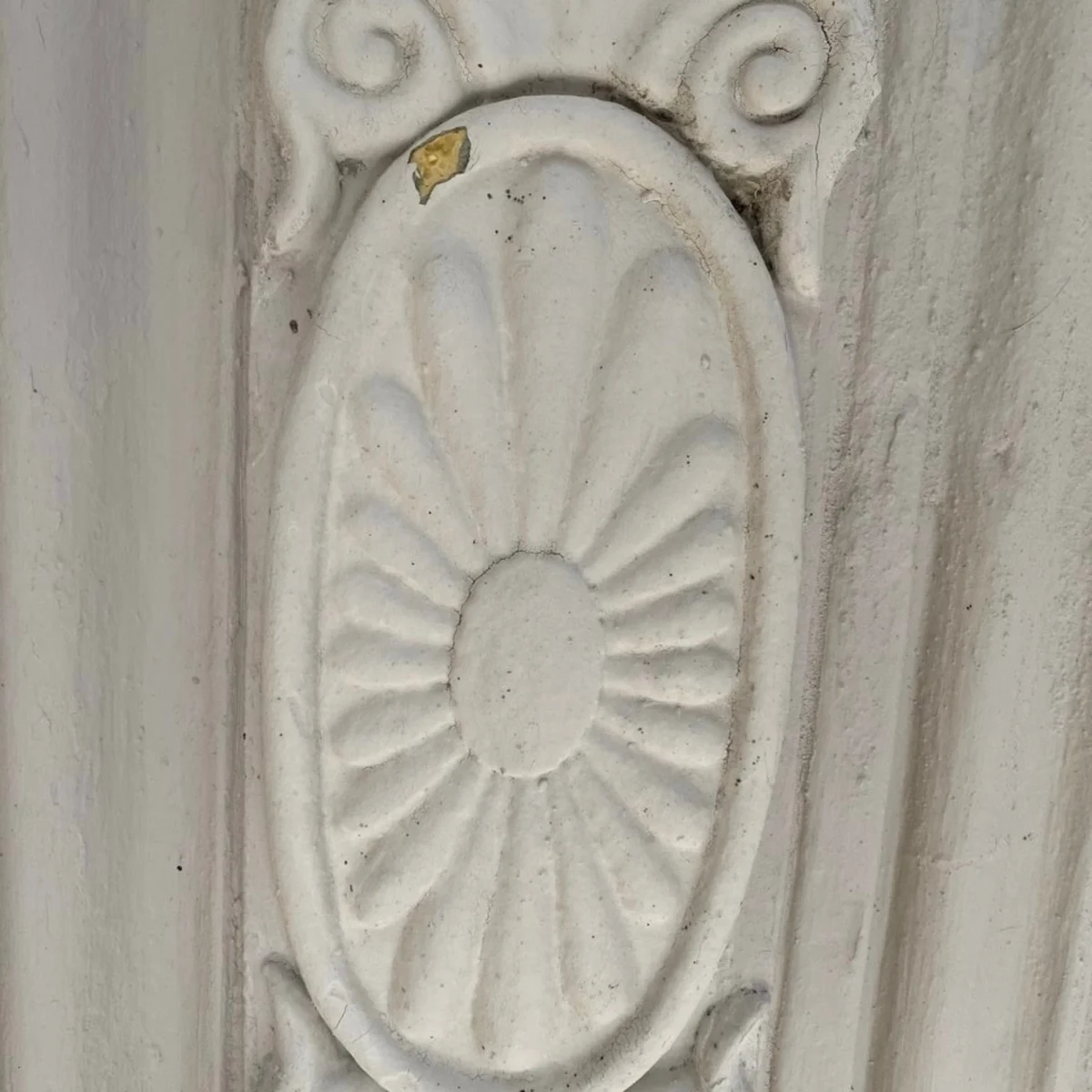
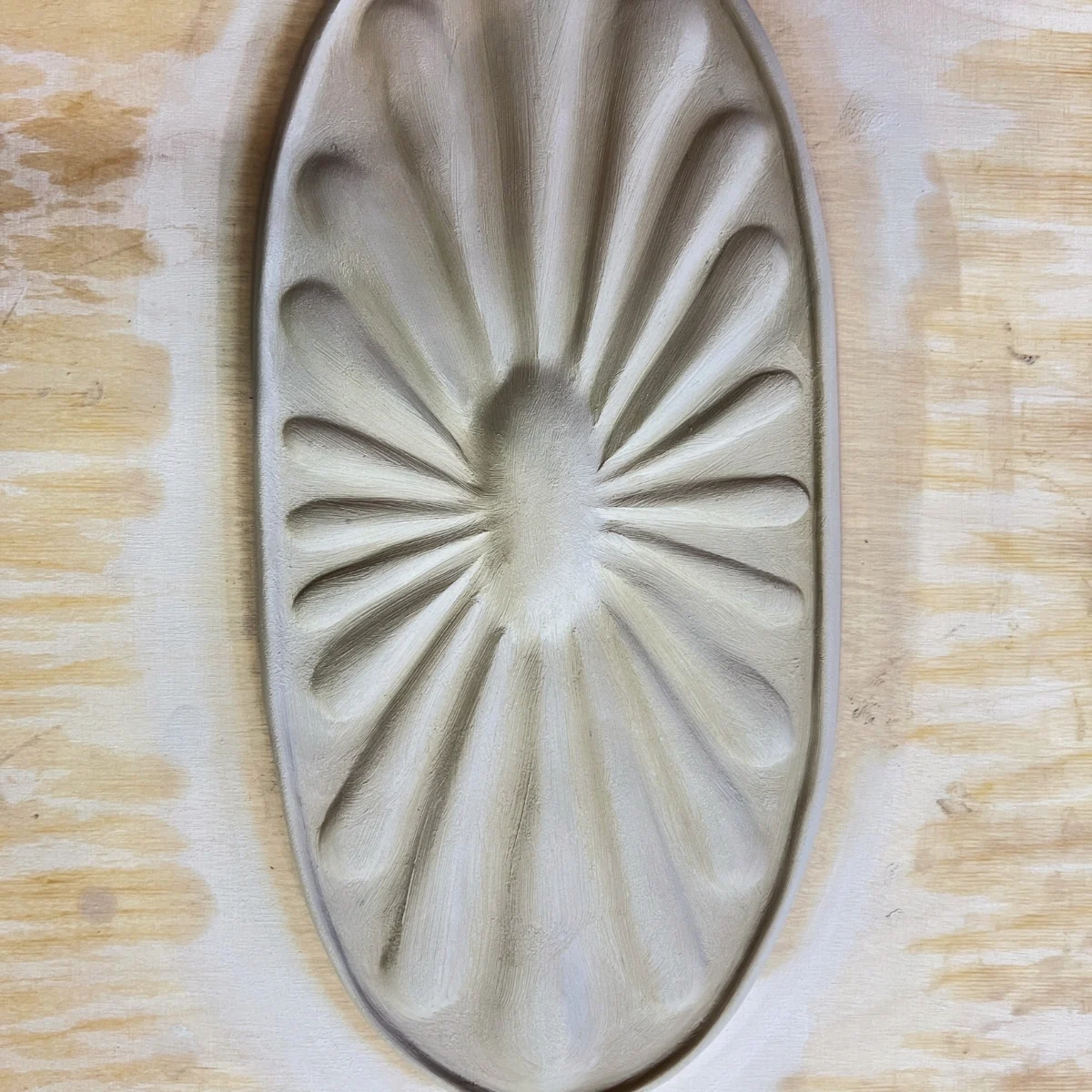
This work was important to me because there was no need to create something new merely to replace what had decayed. It was possible to go back to the building's own history and restore its original ornament.
In this way the building regained its own decoration rather than a substitute for it.
Get in touch and together we will create something incredible.
You can deepen the personal meaning by marking a piece with initials, a personal dedication, or a date that marks an important event. You will find everything you need to know on this page – Individual orders.
In closing
The search for sustainability in ceramics means to me almost the same thing as creative work in general.
To keep asking myself what, out of everything I do, truly has the right to remain.
This question cannot be answered once and for all, because materials change, processes change, my own outlook changes, and so does what I understand about my work.
That is why I call it a search.
Not because I already have the answer, but because I am still looking for it.
The search for sustainability begins anew every day,
Ramunė